

Lifestyle inflation after moving abroad happens when everyday spending increases without a clear change in lifestyle. Small, repeated expenses—such as coffee, dining, transport, and subscriptions—can add €200–€400 per month over time. This shift is driven by convenience, social adaptation, and changes in spending habits in a new environment.
Disclaimer
The information provided on Finorum is for educational and informational purposes only and does not constitute financial, investment, housing, or legal advice. While we aim to use reliable data sources and accurate analysis, economic conditions, housing markets, and living costs can vary significantly across countries and cities. Readers should conduct their own research and consider their personal financial circumstances before making housing, relocation, or financial decisions. Finorum does not promote or endorse specific financial products, housing providers, or investment strategies.
Lifestyle Inflation After Moving Abroad: The Behavioural Shift Behind It
Lifestyle inflation after moving abroad rarely begins with a conscious decision.
It begins with context.
Daily life changes quickly in a new country. New routines, unfamiliar pricing, and different expectations all influence how money is spent. Decisions that once required thought become automatic.
And that shift tends to happen faster than most people expect.
Take Nora in Berlin. In her first months, she relied on convenience — central supermarkets, ready meals, frequent coffee stops. Not because she intended to spend more, but because she was still adapting.
That’s where the difference starts.
In behavioural finance, this is a well-documented pattern of habit disruption and adaptation. When people enter unfamiliar environments, they rely less on established habits and more on immediate decisions. Those decisions tend to favour convenience over optimisation.
The mechanism is straightforward.
You don’t yet know what is expensive and what is not. You don’t know where locals shop, how they plan their spending, or what alternatives exist.
So you default to what is easiest.
And easy is rarely the most cost-efficient option.
This is where lifestyle inflation after moving abroad starts to take shape in everyday decisions.
More broadly, this is how spending habits abroad shift without explicit awareness — not through large upgrades, but through small, repeated choices that gradually increase overall costs.
And over time, these patterns begin to reflect the hidden reasons spending increases abroad, even when income remains unchanged in nominal terms.
This is how small decisions gradually redefine what feels normal in everyday spending.
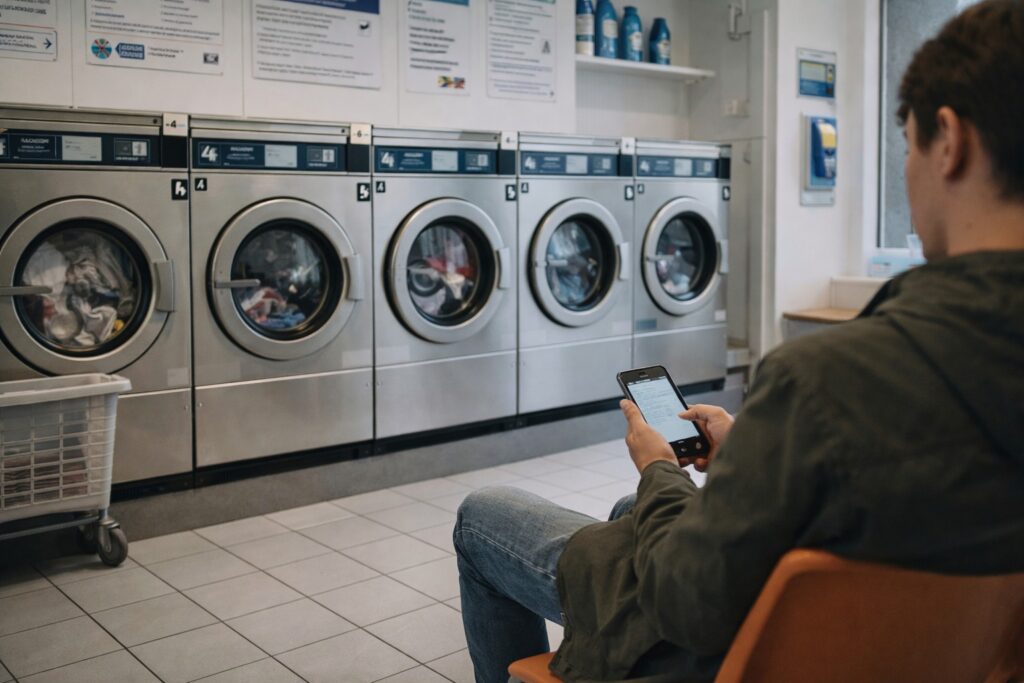
Everyday Spending Abroad: How Small Costs Add €200–€400 a Month
Lifestyle inflation rarely appears as a single large expense.
It builds through repetition.
Coffee, lunch, transport, subscriptions, occasional delivery — each cost feels routine. Individually, they seem too small to matter.
But frequency changes the outcome.
Take a simple example. A €3–€4 coffee on most workdays adds up to €70–€90 per month. Add two lunches per week at €12–€15, and the number moves toward €120–€150. Include delivery or convenience spending, and total everyday spending in European cities can easily increase by €250–€400 per month.
Without a deliberate lifestyle upgrade.
This is where lifestyle inflation after moving abroad becomes measurable.
In many European cities, payment systems are designed to reduce friction. Contactless payments, mobile wallets, and subscription services make transactions faster and less noticeable.
That shift in how payments are made tends to change behaviour.
In consumer behaviour research, this is widely linked to a reduced “pain of paying” — when transactions feel easier, spending tends to increase. Not because people intend to spend more, but because each decision feels less significant in isolation.
The mechanism is straightforward.
You don’t actively evaluate each expense.
You repeat it — often without noticing.
And repetition creates structure.
Take Emil in Copenhagen. His fixed costs remained stable, but his daily spending — coffee, quick meals, short transport rides, digital subscriptions — increased gradually. Over time, his monthly budget shifted without any single expense standing out.
This pattern helps explain why expenses increase after moving abroad, even without a single obvious trigger.
And here’s the key point.
The increase does not come from one decision.
It comes from many small ones.
And once those decisions become routine, they are no longer perceived as optional.
How Social Life Abroad Accelerates Lifestyle Inflation
Lifestyle inflation after moving abroad is not only individual.
It is social.
Moving to a new country changes how often you say yes — to dinners, drinks, events, weekend trips. Not as a deliberate financial decision, but as part of adapting to a new environment.
And that shift compounds quickly.
Take Luca in Milan. Back home, his social routine was stable and relatively predictable. After relocating, his calendar filled up — more frequent dinners, more invitations, more spontaneous plans.
Nothing excessive — but simply more frequent.
That difference matters.
An extra €20–€30 per outing may not seem significant. But repeated multiple times per week, it can easily translate into €200–€400 per month in additional spending.
Without a clear sense of overspending.
This is where lifestyle inflation after moving abroad accelerates.
In behavioural terms, people tend to adjust their spending to match their environment — rather than their original budget. Social norms, pricing expectations, and group behaviour all influence what feels reasonable.
And in a new country, those reference points are still forming.
That is where the financial risk emerges.
You don’t just adapt to prices.
You adapt to people.
And here’s the subtle part.
Saying no consistently is harder when everything feels temporary. The experience of living abroad carries an implicit pressure to participate — to explore, to connect, to make the most of the opportunity.
This is one of the key drivers behind why lifestyle inflation happens after moving abroad, and one of the main ways expat lifestyle inflation develops over time.
And over time, that behaviour becomes part of your baseline — not an exception.
When Higher Spending Becomes Your New Normal Abroad
Lifestyle inflation does not only increase spending.
It resets expectations.
Over time, repeated behaviours — daily purchases, social spending, convenience decisions — stop feeling like choices and start feeling like defaults.
That’s the shift.
What was once occasional becomes routine. What was once avoidable becomes expected. And what once felt expensive no longer stands out.
This is where lifestyle inflation after moving abroad becomes structurally embedded.
In behavioural terms, this is closely linked to mental accounting. People adjust their internal reference points — redefining what counts as “normal” spending.
And once that baseline changes, reversing it becomes difficult.
Not because prices are higher.
But because perception has changed.

Common Mistakes That Make Lifestyle Inflation Worse Abroad
- Underestimating small daily expenses
- Assuming your old budget will still apply
- Treating social spending as “temporary”
- Ignoring structural costs like taxes and insurance
- Not tracking spending in the first 3–6 months
- Over-relying on convenience and delivery
Conclusion
Lifestyle inflation after moving abroad is rarely a conscious upgrade.
It is an adjustment.
New environments reshape spending faster than people realise. Everyday decisions become more frequent, social patterns expand, and small costs begin to accumulate without clear visibility.
Individually, none of these changes seem significant.
Together, they are.
That’s the shift.
In many cases, the issue is not higher prices — but a higher tolerance for spending within a new context.
And once that tolerance changes, spending patterns follow.
That is why lifestyle inflation after moving abroad happens so quickly — and why it is often recognised only after it has already taken hold.
Key Takeaways
- Lifestyle inflation after moving abroad is driven more by behaviour than income.
- Spending increases gradually through small, repeated daily expenses.
- Everyday spending in European cities can add €200–€400 monthly without clear awareness.
- Convenience and frictionless payments increase spending frequency.
- Social adaptation plays a major role in expat lifestyle inflation.
- New environments shift what feels “normal” in spending.
- Structural factors (taxes, insurance) amplify financial pressure.
- Most people underestimate how quickly spending habits adjust.
- The gap is rarely one large expense — but many small ones.
- Awareness typically comes after the pattern is already established.
Methodology
This article is based on behavioural finance frameworks, cross-country cost comparisons, and typical consumption patterns observed across European cities.
The analysis combines:
- Eurostat-style household consumption data
- Observed spending behaviour in urban European environments
- Established concepts such as mental accounting and frictionless payments
All numerical examples (e.g. daily expenses, monthly accumulation) are illustrative and based on realistic price ranges rather than fixed averages.
The focus is on behavioural and structural drivers of spending rather than country-specific price comparisons.
Sources
Primary data sources and research frameworks used in this analysis:
Eurostat
Household consumption expenditure – COICOP classification
Final consumption expenditure of households by consumption purpose
OECD
Consumer behaviour insights and cost-of-living comparisons
European Commission
Consumer conditions and spending patterns across EU countries
Numbeo
Indicative price comparisons across European cities
Behavioural finance references:
Daniel Kahneman & Amos Tversky
Prospect Theory and decision-making under uncertainty
Richard Thaler
Mental accounting (behavioural framework for consumer spending decisions)
Data accessed: March 2026
FAQ
Lifestyle inflation after moving abroad happens because spending habits adapt faster than awareness. New routines, social patterns, and convenience spending increase how often you spend, even when income stays the same. Over time, these small changes raise your overall monthly costs without a clear trigger.
In most cases, lifestyle inflation begins within the first few months. Small daily expenses—such as food, transport, and social spending—quickly accumulate, making the increase noticeable over time rather than immediately.
Lifestyle inflation after moving abroad can increase monthly spending by €200–€400. This usually comes from everyday expenses like coffee, dining, transport, and subscriptions rather than large one-time purchases.
The main drivers include convenience spending, social adaptation, lack of local cost awareness, and frictionless payment systems. These factors increase the frequency of spending rather than the size of individual purchases.
Not necessarily. Prices may remain similar, but spending increases due to behaviour. Lifestyle inflation is driven more by how often you spend than by how much things cost individually.
Money often feels tighter because spending becomes more frequent. Small, repeated expenses add up over time, while new social and behavioural patterns change how money is used in everyday life.
Yes. The first step is awareness. Tracking daily expenses, identifying recurring costs, and adjusting convenience spending can help reduce unnecessary expenses without major lifestyle changes.
Yes, especially in the early stages. Expats are still adapting to a new environment, which makes them more likely to rely on convenience and social spending.
In most cases, yes. Once routines stabilise and spending becomes more intentional, it is possible to reduce unnecessary costs and regain control over expenses.
Matias Buće has a formal background in administrative law and more than ten years of experience studying global markets, forex trading, and personal finance. His legal training shapes his approach to investing — with a focus on regulation, structure, and risk management. At Finorum, he writes about a broad range of financial topics, from European ETFs to practical personal finance strategies for everyday investors.
Sources & References
EU regulations & taxation
- European Commission / Taxation & Customs — COICOP classification
- Consumer conditions and spending patterns across EU countrie
- Final consumption expenditure of households by consumption purpose