


Rent is usually the largest expense in any European city. But in many cases, it is not the one that determines whether you save money at the end of the month. The real difference often comes from small everyday expenses and how they shape the cost of living. A coffee on the way to work. A takeaway instead of cooking. A taxi instead of public transport. A handful of subscriptions running quietly in the background. Individually, these costs feel minor. Together, they can exceed what many people expect. This is where the real shift in the cost of living begins. In some European cities, it is no longer just about how much you pay for rent. It is about how often — and how automatically — you spend on everything else.
Disclaimer
The information provided on Finorum is for educational and informational purposes only and does not constitute financial, investment, housing, or legal advice. While we aim to use reliable data sources and accurate analysis, economic conditions, housing markets, and living costs can vary significantly across countries and cities. Readers should conduct their own research and consider their personal financial circumstances before making housing, relocation, or financial decisions. Finorum does not promote or endorse specific financial products, housing providers, or investment strategies.
Why Small Everyday Choices Matter More Than Rent in Some Cities
Rent is typically the largest single expense in any household budget.
In most European cities, it can account for around 30% to 50% of monthly net income, depending on location and income levels. It is the cost people focus on first — and often the one they try to optimise the most.
But rent has one important characteristic.
It is relatively fixed.
Once paid, it does not change from day to day. It is predictable, visible and easy to track. You know exactly how much it costs each month.
Everyday spending works differently.
Unlike rent, small daily expenses are variable. They depend on habits, routines and individual choices. A coffee here, a delivery there, a ride instead of a walk — each decision may seem insignificant in isolation.
But they repeat.
And repetition changes everything.
A €3 coffee every weekday, for example, quickly turns into €60–€70 per month — before adding anything else.
Over a month, these small expenses accumulate in ways that are less visible than rent but often more dynamic. While rent sets a baseline for the cost of living in European cities, everyday spending determines how far above that baseline your total expenses actually rise.
Daily expenses are becoming an increasingly important part of the cost of living in European cities.
This is why, in some cases, small everyday choices can have a significant impact alongside rent itself.
Not because they are larger individually — but because they are continuous, flexible and often underestimated.
Rent Is Fixed — Everyday Spending Is Not
Rent sets the baseline of your monthly budget.
But everyday spending determines how far above that baseline you actually go.
This is where the difference becomes visible.
Unlike rent, daily expenses are not paid once. They repeat throughout the month — often automatically, often without much thought.
Take a simple example.
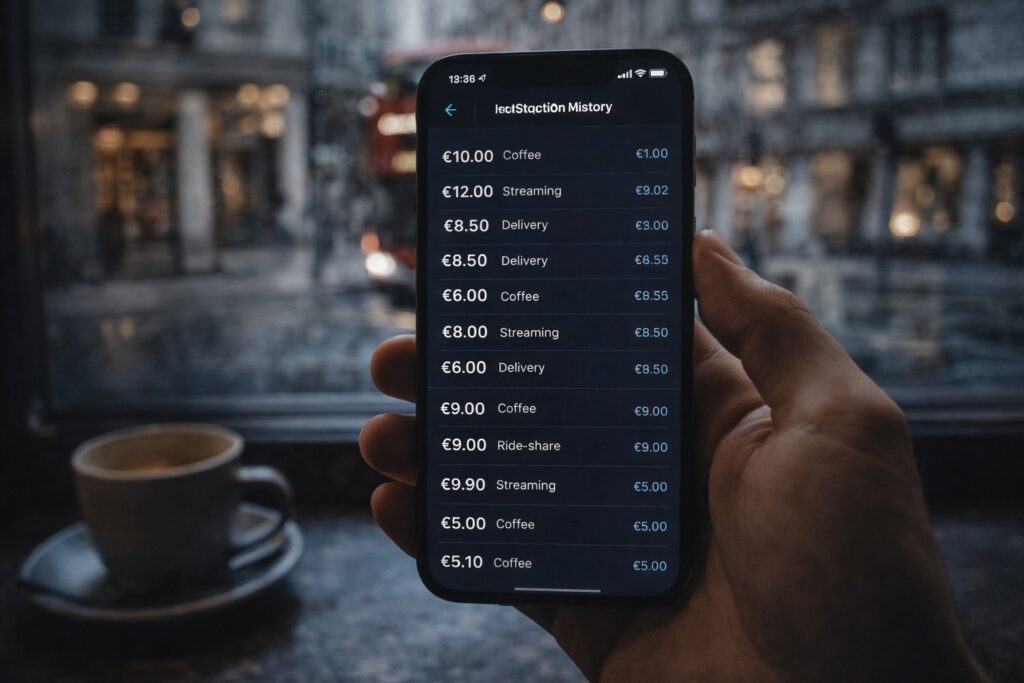
A €3 coffee during the workweek may not seem significant. But over a month, it can reach €60–€70. Add a few takeaway meals at €15–€25 each, and the total quickly climbs to €150–€250. Occasional taxi rides instead of public transport can add another €50–€100.
Individually, these expenses feel manageable.
Together, they begin to rival a meaningful share of fixed housing costs.
And unlike rent, they are harder to control.
Rent is negotiated once. Daily spending is negotiated constantly — through habits, routines and convenience. Each decision is small, but the number of decisions is large.
This creates a different kind of financial pressure.
Not a single large payment, but a continuous flow of smaller ones. Over time, this flow can significantly reshape a monthly budget and increase the real cost of living in European cities.
For many people, this is where budgets start to slip.
Not because of one major expense, but because of dozens of small ones that are repeated every day.
How Small Expenses Shape the Cost of Living in European Cities
The impact of small everyday choices becomes clearer when looking at how households spend money in practice.
According to Eurostat, households in the European Union allocate roughly 16–17% of their total consumption to food and non-alcoholic beverages. This primarily reflects grocery spending, while restaurant meals and takeaway services are recorded separately.
This distinction matters.
Cooking at home is typically one of the most cost-efficient ways to manage daily expenses. But when everyday choices shift towards convenience — such as ordering food more frequently or eating out — spending can increase significantly without a noticeable change in lifestyle.
And food is only one part of the equation.
Transport, digital services and leisure-related expenses follow a similar pattern. Each category may represent a relatively small share of total spending on its own, but together they form a growing layer of variable costs within household budgets.
This is what makes everyday spending so important.
It is not concentrated in a single category. It is distributed across multiple areas of consumption — making it less visible, but more persistent.
Daily expenses and convenience spending are becoming a growing part of the cost of living in European cities.
Over time, these patterns begin to shape the overall cost of living.
In many European cities, the difference between a tight budget and a comfortable one is not always determined by rent alone, but by how frequently individuals rely on convenience-driven spending across these everyday categories.
The Psychology Behind Daily Spending Habits
Understanding everyday spending is not just about numbers.
It is also about behaviour.
Small expenses are often underestimated because they are perceived differently from large, one-off costs. Paying rent feels significant. It is a single, visible transaction. Daily expenses, on the other hand, are fragmented and repeated — making them easier to ignore.
This is where behavioural patterns begin to matter.
Many consumers mentally separate small purchases from their overall budget. A coffee, a subscription or a takeaway meal is rarely evaluated as part of total monthly spending. Instead, each expense is judged individually, often as affordable or justified in the moment.
Friction also plays a role.
Modern payment systems are designed to make spending easier. Contactless payments, stored card details and subscription renewals reduce the need to actively think about each transaction. The process becomes seamless — and as a result, less noticeable.
This changes how spending feels.
When paying becomes easier, the psychological impact of spending becomes weaker. The decision to spend requires less effort, and repeated spending becomes more likely.
Over time, these habits form a pattern.
What begins as occasional convenience gradually becomes routine behaviour. And once a habit is established, it is rarely questioned — even if the cumulative cost continues to grow.
This is why small everyday choices can have such a strong effect on the cost of living.
Not because they are individually significant, but because they are repeated, normalised and often invisible in the moment they occur.
Conclusion
Rent remains the largest and most visible expense in most European cities.
But it is not always the one that determines how much you actually spend by the end of the month.
That role increasingly belongs to everyday decisions.
A coffee, a delivery, a subscription, a ride instead of a walk — each choice feels small in isolation. Yet over time, these decisions form a pattern that quietly shapes the total cost of living.
This is the shift that many people overlook.
Rent is fixed and predictable. Everyday spending is flexible, repeated and often invisible in the moment it happens. And because of that, it has a different kind of impact on personal finances.
Not sudden, but cumulative.
In many cases, the difference between a controlled budget and a stretched one is not defined by rent alone, but by how consistently convenience and small daily expenses are part of everyday life.
This is especially true for people living alone.
Without shared costs or external constraints, everyday spending becomes easier to justify and harder to track. Over time, it can increase the real cost of living in ways that are gradual but significant.
In the end, the cost of living in European cities is not shaped only by the largest expenses.
It is shaped by the choices that are repeated most often.
Key Takeaways
- Rent is the largest single expense in most European cities, but it is relatively fixed and predictable
- Small everyday choices — such as coffee, delivery, transport and subscriptions — are variable and repeat throughout the month
- Daily expenses can accumulate quickly, often without being immediately visible in a monthly budget
- A €3 daily coffee can reach €60–€70 per month, before adding other routine expenses
- Convenience-driven spending increases total consumption rather than replacing essential costs
- Everyday spending is distributed across multiple categories, making it harder to track and control
- Daily expenses and convenience spending are becoming a growing part of the cost of living in European cities
- Behavioural factors — such as frictionless payments and habit formation — make small expenses easier to justify and repeat
- The financial impact of everyday spending is cumulative rather than immediate
- In many cases, the difference between a stable and a stretched budget is shaped by repeated daily choices, not rent alone
Methodology
This article combines household consumption data with behavioural analysis to examine how small everyday choices influence the cost of living in European cities.
The analysis draws on Eurostat data on consumption structure to illustrate how essential spending categories — such as food — compare to variable, everyday expenses driven by individual habits and convenience.
Rather than focusing on a single expense category, the article takes a layered approach. It contrasts fixed costs, such as rent, with variable daily expenses including food delivery, transport, subscriptions and other routine purchases that repeat throughout the month.
Illustrative examples (such as coffee, takeaway meals and transport costs) are used to demonstrate how small expenses accumulate over time. These examples are indicative and designed to reflect common urban spending patterns rather than precise household outcomes.
Because spending habits vary across cities, income levels and lifestyles, the figures presented should be interpreted as general benchmarks that highlight structural patterns in everyday consumption.
Sources
Primary data sources used in this analysis:
Eurostat
Structure of consumption expenditure by purpose (COICOP) – hbs_str_t211
Household consumption by purpose – Eurostat Statistics Explained
European Central Bank (ECB)
Macroeconomic consumption data – MNA dataset
Data accessed: March 2026
The analysis combines long-term consumption structure data with behavioural insights to illustrate how daily expenses and convenience-driven spending are becoming an increasingly important component of the cost of living in European cities.
FAQ – Why Small Everyday Choices Matter More Than Rent in Some European Cities
Why Small Everyday Choices Matter More Than Rent in Some European Cities
Yes. Small everyday expenses can significantly affect the cost of living over time. While each purchase may seem minor, repeated daily spending can accumulate and increase total monthly costs.
Why do small expenses matter more than people think?
Small expenses are often underestimated because they are frequent and less visible than large costs like rent. Over time, their cumulative impact can become substantial.
How do daily expenses compare to rent in European cities?
Rent is usually the largest fixed expense, but daily expenses are variable and ongoing. While rent sets a baseline, everyday spending determines how much total costs exceed that baseline.
What are examples of everyday expenses that add up?
Common examples include coffee, food delivery, takeaway meals, ride-hailing services, subscriptions and small daily purchases. Individually small, these costs can add up quickly over a month.
How much can small daily expenses cost per month?
Even simple habits can add up. A daily €3 coffee can reach €60–€70 per month, while delivery, transport and subscriptions can push total extra spending much higher.
Why is everyday spending harder to track than rent?
Everyday spending is fragmented across multiple categories and often involves small, repeated payments. This makes it less visible and harder to monitor compared to a single monthly rent payment.
How does convenience spending increase the cost of living?
Convenience spending adds to essential expenses rather than replacing them. Services like delivery, taxis and subscriptions increase overall consumption and raise the cost of living.
Is everyday spending more impactful for people living alone?
Yes. People living alone typically cover all expenses themselves, without sharing costs. This makes daily spending habits more impactful on their overall budget.
Why do people underestimate small expenses?
Behavioural factors play a role. Frictionless payments, subscriptions and habit-based spending reduce awareness of individual transactions, making small costs easier to ignore.
How can you reduce the impact of daily expenses?
Tracking spending, reviewing subscriptions and limiting convenience-based purchases can help reduce daily expenses. Awareness is key to controlling cumulative costs.
Iva Buće is a Master of Economics specializing in digital marketing and logistics. She combines analytical thinking with creativity to make financial and investment topics accessible to a broader audience. At Finorum, she focuses on translating complex economic concepts into clear, practical insights for everyday readers and investors.