

For a long-term investor who wants one global equity ETF, VWCE, WEBN, VGLA, FWRA and SPYI are the main funds worth comparing in this group. The important differences are not simply their fees. They track different indices, some include small companies and others do not, and their operating histories range from more than a decade to a matter of weeks.
VWCE remains an established all-world option. WEBN and the newly launched VGLA have the lowest published annual charges in this comparison, at 0.07%. VGLA also includes small-cap companies, while SPYI offers similar all-cap coverage with a much longer operating history. Vanguard confirms that VGLA launched on 18 August 2026, tracks the FTSE Global All Cap Index and charges 0.07%.
IWDA is a different proposition: it deliberately excludes emerging markets. SPYL is narrower again, tracking US large caps through the S&P 500. Neither should be treated as a cheaper substitute for a global fund unless that narrower exposure is what you actually want.
Before choosing between near-identical ETFs, check what your broker charges to buy them and how the investment is taxed where you live. A €5 or €10 difference in annual fund costs can easily be overtaken by commissions, spreads or an unfavourable account structure.
2027 planning edition. Sources checked on 26 September 2026. Charges and tax rules reflect information available on that date and are not guaranteed to remain unchanged throughout 2027.
UCITS ETFs compared
| ETF / common ticker | Market coverage | Published annual charge | Approx. annual charge on €10,000 | Main consideration |
|---|---|---|---|---|
| Vanguard FTSE All-World — VWCE | Developed and emerging markets; large and mid caps | 0.14% | €14 | Established global option; no small caps |
| Amundi Prime All Country World — WEBN | Developed and emerging markets; large and mid caps | 0.07% | €7 | Low charge; different benchmark from VWCE |
| Vanguard FTSE Global All-Cap — VGLA | Developed and emerging markets; large, mid and small caps | 0.07% | €7 | Very broad coverage; launched only in August 2026 |
| Invesco FTSE All-World — FWRA | Developed and emerging markets; large and mid caps | 0.15% | €15 | Same FTSE All-World benchmark as VWCE |
| State Street SPDR MSCI ACWI IMI — SPYI | Developed and emerging markets; large, mid and small caps | 0.17% | €17 | All-cap coverage with a longer live history |
| iShares Core MSCI World — IWDA / SWDA | Developed markets; large and mid caps | 0.20% | €20 | Emerging markets require a separate allocation |
| State Street SPDR S&P 500 — SPYL | US large caps | 0.03% | €3 | Deliberate concentration in the US |
All share classes shown are accumulating. The euro figures assume a constant €10,000 holding for one year and exclude brokerage, spreads, currency conversion and investor taxes. Tickers vary between exchanges, so confirm the ISIN before placing an order.
The shortlist concentrates on broad, passive equity ETFs that can perform a clear role in a long-term portfolio. It is not a ranking of every UCITS ETF available in Europe, and recent performance is not being used to choose a winner.
The global ETFs worth comparing
VWCE: established all-world exposure
Vanguard FTSE All-World UCITS ETF USD Accumulating tracks large- and mid-cap companies in developed and emerging markets.
Its published ongoing charge is 0.14%, and Vanguard reported 3,784 stocks in the fund at the end of August 2026.
ISIN: IE00BK5BQT80. Vanguard product information
The appeal is straightforward: one fund covers the major developed and emerging equity markets without requiring you to maintain separate regional allocations.
Its longer operating history is also useful when comparing it with newer competitors. That does not mean an existing VWCE investor should switch simply because another ETF cuts the annual charge by a few basis points. Brokerage costs and tax consequences can be worth much more.
WEBN: lower cost, different benchmark
Amundi Prime All Country World UCITS ETF Acc tracks the Solactive GBS Global Markets Large & Mid Cap Index rather than FTSE All-World.
Its published management and operating costs are 0.07%, and Amundi describes the fund as providing developed- and emerging-market equity exposure.
ISIN: IE0003XJA0J9. Amundi factsheet
Its role is therefore similar to VWCE’s, but the portfolios are not identical because the benchmarks differ.
For someone building a portfolio from scratch, the lower charge makes WEBN worth comparing. For an investor who already owns another broad global fund, the more useful calculation is the cost of changing course.
VGLA: all-cap exposure at 0.07%
Vanguard’s FTSE Global All-Cap UCITS ETF USD Accumulating extends the coverage to small companies as well as large and mid-sized stocks in developed and emerging markets.
The annual charge is 0.07%, the ISIN is IE000VAHT5T0, and Vanguard says the share class launched on 18 August 2026. At the end of August it held 6,429 stocks.
That combination of broad coverage and a low fee is attractive on paper. The trade-off is obvious: the fund has almost no live operating history yet. Availability, bid–ask spreads and inclusion in your broker’s savings plan may matter more initially than the headline OCF.
FWRA: almost the same fee as VWCE
Invesco FTSE All-World UCITS ETF Acc tracks the same FTSE All-World benchmark used by VWCE.
It launched in June 2023 and has a published ongoing charge of 0.15%.
ISIN: IE000716YHJ7. Invesco factsheet
On €10,000, the difference between an annual charge of 0.14% and 0.15% is about €1 a year before changes in the portfolio value.
That is why the broker often decides this comparison. Paying an extra commission to buy the ETF with the one-basis-point-lower fund charge can wipe out years of the apparent saving.
SPYI: small caps with a longer record
The State Street SPDR MSCI All Country World Investable Market UCITS ETF tracks the MSCI ACWI IMI index, covering developed and emerging markets across large, mid and small companies.
It launched in 2011 and currently has a 0.17% TER. State Street says the fund uses optimised replication.
ISIN: IE00B3YLTY66. State Street product information
Compared with VGLA, SPYI charges more but has more than a decade of operating history. That distinction is more meaningful than treating the 0.10-percentage-point fee gap as the entire decision.
IWDA and SPYL solve different problems
iShares Core MSCI World UCITS ETF USD Acc, commonly traded under IWDA or SWDA, covers developed markets rather than the whole global market.
Its TER is 0.20%, it is accumulating and its ISIN is IE00B4L5Y983. BlackRock reported about 1,250 holdings on 24 September 2026.
IWDA makes sense when developed markets are the intended allocation, or when you deliberately want to manage an emerging-market position separately. It does not provide the same coverage as an all-country fund.
State Street SPDR S&P 500 UCITS ETF Acc — SPYL is narrower still. It tracks US large-cap equities and charges 0.03%. State Street lists the ISIN as IE000XZSV718.
State Street product information
S&P 500 companies earn revenue around the world, but that does not turn the fund into a global equity allocation. Buy an S&P 500 ETF because you want greater exposure to US large companies, not simply because 0.03% looks cheaper than the fee on a world fund.
ETF fees matter — but calculate the difference in euros
For a first approximation:
Annual fund charge ≈ average amount invested × annual charge
A €20,000 position in a fund charging 0.15% costs roughly €30 a year in published ongoing charges. These costs are reflected in the fund’s value rather than normally arriving as a separate annual bill.
For regular investors, transaction costs can have a much larger effect:
| Amount invested per purchase | €1 commission | €3 commission |
|---|---|---|
| €50 | 2.00% | 6.00% |
| €100 | 1.00% | 3.00% |
| €300 | 0.33% | 1.00% |
| €1,000 | 0.10% | 0.30% |
Someone investing €50 each month and paying €1 for every purchase spends €12 a year in commissions. Moving from one broad ETF to another to save a few euros in annual fund charges does not solve that cost problem.
A cheaper savings plan or less frequent purchases could reduce the fixed-fee drag. Less frequent purchases also leave cash uninvested for longer, so calculate the amounts rather than treating either schedule as automatically superior.
Do not add TER to tracking difference
TER and tracking difference tell you different things.
The fund charge describes the published cost of operating the ETF. Tracking difference compares the fund’s realised return with its benchmark over a particular period. Because reported fund performance already reflects ongoing charges, simply adding the TER to an observed tracking shortfall can count the same cost twice.
Use TER to compare pricing. Use tracking difference to examine how funds have actually implemented their indices, making sure the periods, currencies and benchmark versions are comparable.
Should you switch to a cheaper ETF?
A lower annual charge does not automatically justify selling what you already own.
A simple starting calculation is:
Break-even period = one-off switching costs ÷ estimated annual fee saving
Suppose you hold €20,000 and another comparable ETF is 0.10 percentage points cheaper each year. The estimated annual saving is €20.
If selling your existing ETF and buying the replacement costs €60 in commissions and estimated spreads, the simple break-even period is:
€60 ÷ €20 = three years
That calculation assumes the portfolio value does not change and ignores tax, future fee changes and differences in tracking.
Tax can completely alter the result. If selling crystallises a taxable gain, the cost of bringing that tax payment forward belongs in the comparison.
There is also a less disruptive option: keep the existing fund and direct new contributions to the alternative. That avoids a sale, although it leaves you with an additional holding to administer.
One global ETF or several?
More ETFs do not necessarily mean more diversification.
| Combination | What it actually changes |
|---|---|
| VWCE + FWRA | Splits similar FTSE All-World exposure between providers |
| Global ETF + S&P 500 ETF | Increases the portfolio’s US large-cap weight |
| MSCI World + emerging-markets ETF | Adds a region MSCI World excludes |
| All-World ETF + small-cap ETF | Adds companies outside a large/mid-cap index |
| Global equity ETF + bond ETF | Changes the portfolio’s overall equity/bond risk |
Consider a hypothetical global ETF that is 60% invested in the US. If 80% of a portfolio goes into that fund and 20% into an S&P 500 ETF:
US allocation = (80% × 60%) + (20% × 100%) = 68%
The 60% figure is illustrative, not the current weight of a particular fund.
The second ETF has increased US exposure by eight percentage points. It has not filled a missing geographic gap. That may be exactly what you want — but it should be a deliberate overweight rather than accidental overlap.
Where bonds fit
One example of a separate bond allocation is the iShares Core Global Aggregate Bond UCITS ETF EUR Hedged Acc, commonly traded as AGGH.
Its published TER is 0.10% and its ISIN is IE00BDBRDM35. The EUR-hedged share class seeks to reduce exchange-rate exposure against the euro, but the fund still carries interest-rate and credit risk. iShares factsheet
A bond ETF is not a cash account. Decide first whether you need bonds in the portfolio; only then does choosing a particular bond fund become useful.
How your contribution size changes the decision
If you invest €50 to €100 a month, start with the mechanics. Check the minimum savings-plan amount, dealing commission and whether the service supports fractional investing under terms you understand.
One broad global equity fund can be easier to maintain than splitting each small contribution between several ETFs, particularly if each transaction carries a fixed charge.
If you are still deciding how much cash should be invested at all, see Finorum’s guide to investing €1,000 in Europe.
At €300 to €500 a month, the comparison changes. Several global ETFs may be economically viable, so the broker’s recurring-investment terms, benchmark, ISIN and account eligibility become more useful differentiators.
For a six-figure existing portfolio, switching costs and tax can matter more than a modest TER reduction. Cutting annual costs by 0.07 percentage points on €100,000 saves roughly €70 a year before changes in portfolio value. That is worth calculating, but it does not by itself justify selling a large position.
If you expect to move between European countries, retain purchase dates, acquisition costs and transaction records. The ETF may remain unchanged while the tax treatment, reporting obligations and even your broker’s ability to serve you change.
Tax residence can change the ETF decision
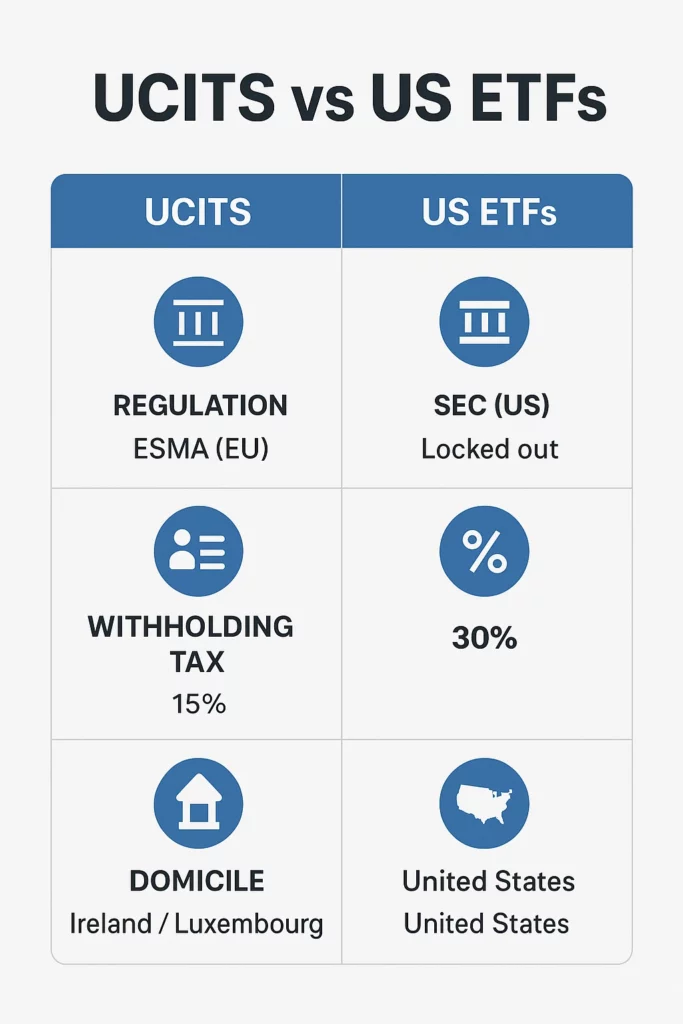
There is no European-wide ETF tax regime. Fund domicile, broker location and your own tax residence are separate questions.
Selected examples show why the local rules should be checked before selecting an ETF:
| Tax residence | Issue to check | Why it matters |
|---|---|---|
| Germany | Qualifying equity funds can receive a 30% partial exemption; the Vorabpauschale can also produce taxable income without a sale | Accumulating does not necessarily mean tax is postponed until disposal |
| France | Qualifying PEA gains withdrawn after five years are exempt from income tax, while social contributions still apply | Account structure and fund eligibility can matter more than a small TER difference |
| Spain | The traspasos tax-deferral regime for qualifying fund transfers does not generally give ETFs the same treatment | A conventional index fund may deserve comparison with an ETF |
| Ireland | The individual rate applying to relevant investment-fund income and gains fell to 38% from January 2026; the fund regime can also involve eight-year deemed disposal | Establish the ETF’s tax classification rather than assuming ordinary CGT treatment |
| Austria | OeKB publishes tax data and identifies KESt-Meldefonds | Search the exact ISIN and check how the broker handles Austrian tax reporting |
Germany’s Investment Tax Act provides a 30% partial exemption for qualifying equity funds for private investors.
France’s tax authority states that qualifying PEA gains withdrawn after five years are exempt from income tax, although social contributions remain payable. Its page was updated in July 2026.
Ireland’s Revenue confirmed that Finance Act 2025 reduced the relevant individual investment-undertaking tax rate from 41% to 38% from 1 January 2026.
Austria’s OeKB provides fund tax data and a list of KESt-Meldefonds, which makes the exact ISIN worth checking before purchase.
The original country comparison and primary-source references are set out in the source article.
Accumulating versus distributing is also a tax question
An accumulating ETF reinvests income within the fund. A distributing ETF pays income out.
That distinction affects cash flow, but it does not by itself tell you when or how you will be taxed. Automatic reinvestment and personal tax deferral are different concepts.
Finorum’s guide to accumulating versus distributing ETFs in Europe covers the issue in more detail.
The same caution applies to domicile. Buying an Irish-domiciled ETF does not make an investor resident elsewhere subject to Ireland’s domestic tax regime for Irish resident investors.
A five-step ETF selection process
- Decide what exposure you need. Global equities, developed markets, a deliberate US allocation and bonds are different portfolio jobs.
- Check the account and tax treatment. Establish which wrappers, allowances, reporting rules and eligibility restrictions apply where you live.
- Compare funds that perform the same job. Look at the benchmark, company-size coverage, charge, replication approach and operating history.
- Calculate your own trading costs. Include commissions, spreads, currency conversion and savings-plan conditions.
- Confirm the instrument before buying. Match the ISIN, accumulating or distributing share class, trading line and any currency hedging.
That order avoids a common mistake: finding the ETF with the lowest published fee first and only later discovering that it has the wrong exposure, is expensive to buy through your broker or is awkward under your local tax rules.
Risks that a low TER does not solve
Global equity ETFs can fall sharply. Owning thousands of shares limits the damage from one company failing, but it does not protect against a broad market decline.
Trading in euros does not remove currency risk. A EUR trading line determines the currency in which you buy and sell. It does not automatically hedge the currencies of the companies held inside a global ETF.
A global ETF can still be concentrated. Market-cap-weighted indices give the largest companies and markets the greatest weights. Thousands of holdings do not mean every country or company has equal influence.
UCITS is a regulatory framework, not a capital guarantee. The rules establish requirements for eligible funds; they do not protect investors from falling market prices. See the EU UCITS Directive.
Fees and broker offers change. Reviewing them periodically is sensible. That does not mean a cheaper new ETF automatically creates a reason to trade.
FAQ
Why can the same ETF have several tickers?
One ETF share class can trade on several exchanges and in several currencies, with a different ticker on each venue.
Use the ISIN to identify the share class first. Then compare the exchange, trading currency, spread and dealing fee.
Is a €5 ETF cheaper than an ETF whose shares cost €100?
Not in the sense that matters for investment value.
The share price tells you how much one unit costs. It can matter if your broker requires whole-share purchases, but it does not tell you whether the portfolio is cheaper to operate or offers better exposure.
Compare the TER, benchmark and trading costs separately.
Can I invest less than the price of one ETF share?
Some brokers support fractional purchases or recurring savings plans.
Check what you legally own, whether the fractional position can be transferred to another broker and what happens when you sell. Do not assume every fractional service works exactly like ownership of a whole exchange-traded share.
Should I choose whichever ETF had the strongest return last year?
Not before checking what it owns.
A difference in one-year performance may result from different country weights, small-cap exposure, benchmark construction or currency movements. A fund tracking a different market is not outperforming another fund at the same job.
First compare ETFs with genuinely similar exposure.
Do accumulating ETFs avoid dividend withholding tax?
No. Reinvesting income does not eliminate taxes that arise inside the fund.
Dividends received by the ETF can be subject to withholding before the remaining income is reinvested. That fund-level taxation is separate from whatever tax you personally owe.
Do I need to change ETF because the calendar changes to 2027?
No. A new year is a reason to verify fees, product terms and tax rules, not a reason to sell an otherwise suitable investment.
Reconsider the fund when something material changes: its benchmark or charges, its tax treatment, the account you use, or your own investment plan.
Disclaimer: The information provided on Finorum is for educational and informational purposes only and does not constitute personalised financial, investment or tax advice. Investing involves risk, including the potential loss of capital. Always conduct your own research and, where needed, consult a qualified financial or tax adviser before making investment decisions. Tax treatment depends on individual circumstances and applicable rules, which can change over time.
Iva Buće is a Master of Economics specializing in digital marketing and logistics. She combines analytical thinking with creativity to make financial and investment topics accessible to a broader audience. At Finorum, she focuses on translating complex economic concepts into clear, practical insights for everyday readers and investors.
Sources & References
EU regulations & taxation
Additional educational resources
- Amundietf.co.uk — Amundi factsheet
- Global.vanguard.com — Vanguard product information
- Invesco.com — Invesco factsheet
- Ishares.com — iShares factsheet
- iShares product information
- Ssga.com — State Street product information
- State Street product information
- Trading.com
- Vanguard.co.uk — Vanguard product information