
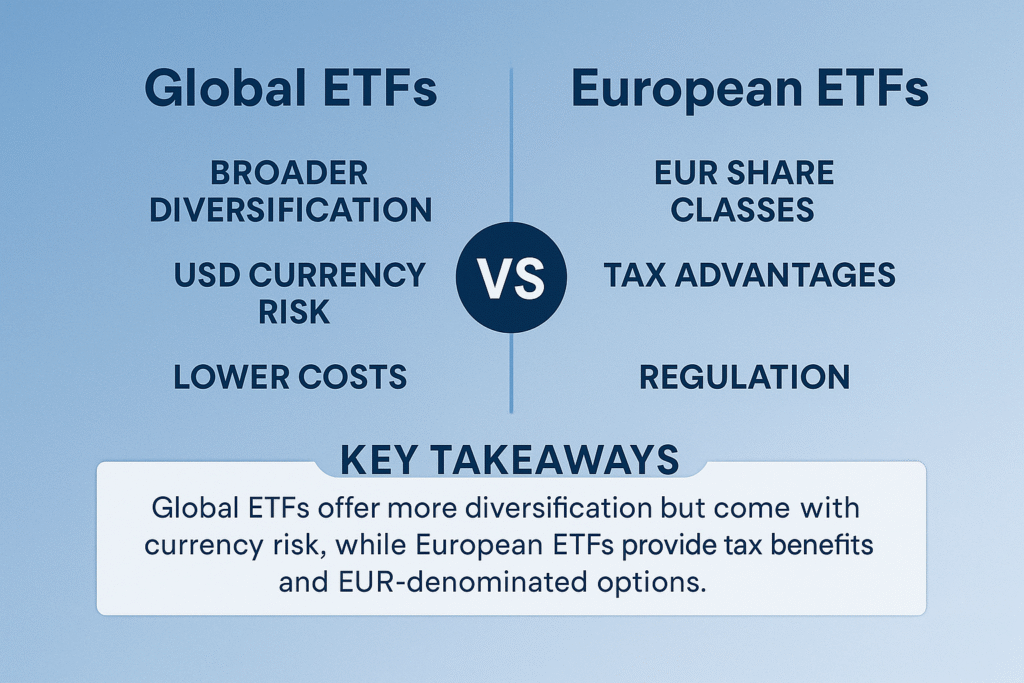
Global vs European ETFs comes down to how much regional exposure you want. For most long-term investors seeking broad equity exposure, a global ETF is the simpler starting point. It already owns European companies alongside businesses from the US, Japan and other markets. Adding a European ETF does not automatically improve diversification; it increases Europe’s weight in the portfolio.
That can be entirely deliberate. You may want less US exposure, more European equities than a market-cap-weighted global index provides, or a regional allocation specified in your investment plan. But the decision is about how much Europe you want to own, not where you live.
You do not need a Europe ETF simply because you are a European investor.
2027 planning edition. Sources checked on 26 September 2026. Index characteristics and tax rules reflect information available on that date. Portfolio weights and return scenarios below are illustrative unless stated otherwise.
Quick answer: global ETF vs Europe ETF
| Decision point | Broad global equity ETF | European equity ETF |
|---|---|---|
| Geographic exposure | Several regions, including Europe | European markets |
| Typical role | Core equity holding | Regional allocation or addition to a global holding |
| US exposure | Included according to the index | Excluded from the European allocation |
| Main concentration risk | Large markets and companies can dominate | Reliance on one region |
| Emerging markets | Included in all-country indices; excluded from MSCI World | Generally absent from developed-Europe indices |
| Currency protection | Only when explicitly hedged | European exposure does not mean euro-only exposure |
The distinction between global, European and UCITS is important. Global and European describe where a fund invests. UCITS describes its regulatory structure.
A fund can therefore be global, domiciled in Ireland, UCITS-compliant and traded in euros at the same time.
Vanguard’s FTSE All-World UCITS ETF is one example: the fund is Irish-domiciled but invests across developed and emerging markets. Its European domicile does not make its portfolio European. Vanguard product information
For this article, European ETF means an ETF investing in European equities. The term does not refer to every ETF domiciled, regulated or listed in Europe.
MSCI World vs MSCI Europe: what do you actually own?
An index name tells you what universe the ETF is trying to track, and some names are easier to misread than others.
MSCI World covers large- and mid-cap companies across developed markets. Despite “World” in the name, it does not include emerging markets. MSCI World index information
MSCI Europe is a regional index covering large- and mid-cap companies in developed European markets. MSCI says it covers roughly 85% of the free-float-adjusted market capitalisation of that universe. MSCI Europe index information
FTSE All-World goes further geographically than MSCI World. It includes developed and emerging markets and covers large- and mid-cap stocks. It offers broader geographic coverage without a dedicated small-cap segment. FTSE Russell index information
| Index | Geographic scope | Company-size coverage | Main point to understand |
|---|---|---|---|
| MSCI World | Developed markets | Large and mid caps | “World” does not include emerging markets |
| FTSE All-World | Developed and emerging markets | Large and mid caps | Broad global exposure, but no dedicated small-cap segment |
| MSCI Europe | Developed European markets | Large and mid caps | Regional exposure that already overlaps with global indices |
| STOXX Europe 600 | Broad European markets | Large, mid and small caps | Wider company-size coverage within Europe |
| EURO STOXX 50 | Eurozone | Selected large companies | Much narrower regional and company exposure |
The STOXX Europe 600 provides broad European coverage across company sizes; the EURO STOXX 50 focuses on eurozone blue chips.
Europe, the European Union and the eurozone are also different investment universes. A broad European index can include UK and Swiss companies; a eurozone benchmark cannot.
If your objective is simply “more Europe”, define what Europe means before choosing the ETF.
Your global ETF already owns European shares
This is the most important calculation in the comparison.
A broad global index already allocates part of its portfolio to European companies. Buying a separate Europe ETF therefore increases an exposure that already exists.
Suppose a hypothetical global ETF is:
- 65% US equities;
- 15% European equities;
- 20% other markets.
These are rounded numbers for illustration, not current weights for a particular fund.
If you then invest 80% of the portfolio in that global ETF and 20% in a Europe-only ETF:
Total European exposure = (80% × 15%) + 20% = 32%
The Europe ETF occupies 20% of the portfolio, but the portfolio’s total European exposure is 32%.
| Portfolio | Europe | US | Other markets |
|---|---|---|---|
| 100% hypothetical global ETF | 15.0% | 65.0% | 20.0% |
| 90% global + 10% Europe | 23.5% | 58.5% | 18.0% |
| 80% global + 20% Europe | 32.0% | 52.0% | 16.0% |
| 70% global + 30% Europe | 40.5% | 45.5% | 14.0% |
Notice what happens to the rest of the portfolio. Adding Europe lowers the US weight, but it also reduces every other region represented by the global fund.
If your only objective is to reduce US exposure, Europe is one possible destination. It is not the only one.
Calculate your European ETF allocation
For a portfolio consisting only of a global ETF and a Europe-only ETF, you can calculate the regional holding needed to reach a target. Use the same definition of Europe for both funds. The formula below applies when the target is at least as high as the European weight already in the global fund:
Europe ETF weight = (target Europe weight − Europe weight in global ETF) ÷ (1 − Europe weight in global ETF)
Using the same hypothetical global fund, suppose you want Europe to make up 30% of the overall portfolio:
(30% − 15%) ÷ (100% − 15%) ≈ 17.6%
That would produce a portfolio of roughly 82.4% global ETF and 17.6% Europe ETF.
The calculation does not imply that 30% Europe is an appropriate target. Use the latest country weights from your own fund’s factsheet rather than the illustrative 15% figure.
When a European tilt has a clear purpose
A separate Europe ETF is easier to maintain when you can describe what it is supposed to change.
You might deliberately want:
- more European equities than the global market gives you;
- less reliance on US equities;
- a regional allocation specified in a written investment plan; or
- additional company-size exposure provided by a particular European index.
Each choice is a departure from global market-cap weighting. That means your portfolio will behave differently from the global benchmark, sometimes for years at a time.
Before adding the fund, decide the total European allocation you want, what circumstances would justify changing it and how you intend to rebalance.
“I want 30% in European equities and will review the allocation annually” is a usable portfolio rule. “Europe looks attractive this year” is a market view that can disappear as quickly as it appeared.
Familiarity is not the same as diversification
Living in Europe can make European companies feel more familiar. That does not automatically make a portfolio concentrated in them safer.
Your salary, home, pension or business may already be linked to the European economy. Those exposures do not translate directly into an ETF percentage, but they are worth remembering before increasing regional exposure simply because local companies feel familiar.
European shares are still equities. Money required for a house deposit or another near-term expense should not depend on European markets recovering before your payment is due.
ETF currency risk: buying in euros does not remove it
The currency in which an ETF trades is not the same thing as the currency exposure of the investments inside it.
A EUR trading line can be convenient because an investor funding an account in euros may avoid a trading-currency conversion. It does not turn an unhedged international portfolio into a euro-hedged one.
Consider a simplified investment consisting entirely of US shares:
- the shares rise by 10% in US-dollar terms;
- the euro value of one US dollar falls by 10%.
The approximate return measured in euros is:
(1 + 10%) × (1 − 10%) − 1 = −1%
The two percentage changes do not simply cancel because they apply sequentially to different bases.
Buying the same exposure through a EUR exchange listing does not remove that exchange-rate effect. CME Group explains how equity and currency returns combine for international investors.
A European ETF is not necessarily euro-only either. Broad European indices can contain British and Swiss companies, while businesses listed in eurozone countries can earn substantial revenue and incur costs in other currencies.
If currency hedging is important to you, look for an explicitly hedged share class and check what is being hedged and at what cost. Do not infer hedging from “EUR” in a trading line or “Europe” in an index name.
Do not choose a region to save €5 a year
Fund charges matter, but an asset-allocation decision should not be driven by a tiny fee difference.
Suppose a global ETF costs 0.15% a year and a European ETF costs 0.10%.
| Illustrative holding | Global ETF at 0.15% | Europe ETF at 0.10% |
|---|---|---|
| €10,000 | €15 | €10 |
| €50,000 | €75 | €50 |
| €100,000 | €150 | €100 |
These are hypothetical examples and exclude brokerage, spreads and tax.
On €10,000, the difference is €5 a year.
But the two portfolios are not substitutes. Paying €10 instead of €15 for a fund that gives you a different regional exposure is not necessarily a saving. You first have to decide which exposure belongs in the portfolio.
Once that decision has been made, comparing fees between ETFs that perform the same job becomes useful.
For individual funds, see Finorum’s comparison of the best UCITS ETFs in Europe.
Two ETFs can also double your dealing costs
Suppose your broker charges €1 per transaction.
One €100 monthly purchase costs 1% of the amount invested.
Splitting that €100 into two €50 purchases costs €2, or 2% of the contribution.
A second ETF can therefore make a small portfolio more expensive even when its fund-level annual charge is lower.
Commission-free savings plans change the arithmetic, but check minimum order sizes, spreads and the cost of eventually selling or transferring the position.
Which performs better: global or European equities?
There is no established winner for 2027.
Historical returns tell you what happened under a particular combination of valuations, earnings, currencies and economic conditions. They do not resolve the future allocation decision.
A meaningful historical comparison also requires the same:
- start and end dates;
- reporting currency;
- treatment of dividends; and
- type of return series.
Comparing a US-dollar index return with a euro-denominated fund return can produce a misleading conclusion. So can comparing a price index that excludes dividends with a fund return that reinvests them.
What adding Europe actually does to performance
Suppose, purely for illustration:
- a global ETF gains 8%;
- a Europe ETF gains 3%;
- the portfolio begins 80% global and 20% Europe.
Ignoring costs, contributions and rebalancing:
Portfolio return = (80% × 8%) + (20% × 3%) = 7%
The mixed portfolio trails the global fund by one percentage point.
Reverse the returns — global 3%, Europe 8% — and the mixed portfolio earns:
(80% × 3%) + (20% × 8%) = 4%
It now leads the global holding by one percentage point.
Neither scenario is a forecast. The calculation shows what the regional tilt does: it makes your results more dependent on Europe’s performance relative to the rest of the global portfolio.
That possibility has to be acceptable in both directions.
How the choice changes with the size of your portfolio
You are starting with €1,000 and adding €100 a month
First establish that the money genuinely belongs in equities rather than your emergency reserve or a near-term savings goal.
For the long-term equity portion, one broad global ETF keeps purchases, costs and record-keeping relatively simple.
A European ETF should be added only if the resulting regional allocation is something you specifically want, particularly when a second monthly transaction creates another fee.
Finorum’s guide to investing €1,000 in Europe covers the initial cash-versus-investment decision.
You invest €300 a month and want more Europe
Start with the European exposure already inside your global fund.
Do not assume putting 20% of each monthly contribution into a Europe ETF means Europe will represent 20% of your portfolio. Your existing holdings already contain European companies, and past market movements affect the current weights.
Set the target at portfolio level. New contributions can then be directed towards the underweight allocation, potentially reducing the need to sell existing holdings.
You already have €100,000 in a global fund
Using the earlier hypothetical 15% European weight, your global fund already contains roughly €15,000 of European equities.
Changing the portfolio to an 80/20 global-Europe mix would increase total European exposure to approximately €32,000, assuming unchanged market prices.
That is not a minor adjustment. It is a substantial regional allocation decision.
Before selling existing holdings, calculate any tax liability and trading costs. If the desired change is not urgent, future contributions may be able to move the portfolio towards the target without immediately realising gains.
Tax treatment depends on your country and account, not just the map
A Europe ETF is not automatically more tax-efficient for somebody who lives in Europe.
Your tax residence, account structure and the legal classification of the fund matter separately from the countries in which its portfolio companies operate.
Germany: look at fund classification
German law provides a 30% partial exemption on income from qualifying equity funds for private investors. The relevant distinction is whether the investment meets the statutory equity-fund conditions, not whether its companies are European or global. German Investment Tax Act, section 20
Compare the classification of the actual funds and the way your broker handles German investment taxation before restructuring the portfolio.
France: PEA eligibility does not necessarily mean Europe-only exposure
For qualifying PEA withdrawals after five years, the French tax authority states that gains are exempt from income tax, while social contributions remain payable. French tax authority guidance on PEA withdrawals
PEA eligibility does not mean every available ETF has to track European equities. Amundi, for example, lists a PEA-eligible MSCI World ETF in its PEA product range.
Check eligibility for the exact fund rather than inferring it from the index name.
Spain: ETF structure can affect rebalancing
Spain’s fund-transfer rules can allow qualifying investment-fund transfers to take place without immediately recognising the gain for personal income-tax purposes. The CNMV’s January 2026 taxation guide describes this tax-deferral mechanism.
The traspasos tax-deferral regime excludes ETFs.
For an investor who expects to rebalance between regions, the difference between an ETF and a qualifying conventional index fund can therefore matter alongside the geographic allocation itself.
Moving to another country
A move can change the administrative and tax treatment even when the investments remain identical.
Before relocating, check whether your broker can continue serving residents of the destination country and how that jurisdiction will treat the account and holdings.
Retain acquisition dates, purchase prices, fees and transaction records. The portfolio’s geographic exposure may stay exactly the same while its reporting obligations change.
Global core, European tilt or a different solution?
| Your objective | Direction to investigate | What to check |
|---|---|---|
| Broad long-term equity exposure with little maintenance | One broad global ETF | Whether it covers developed markets only or developed plus emerging markets |
| More Europe than the global market provides | Global ETF plus Europe ETF | Your total European exposure after overlap |
| Less US exposure without concentrating specifically in Europe | A broader ex-US allocation | Resulting regional mix and additional complexity |
| Eurozone companies specifically | Eurozone benchmark | Narrower geographic and company coverage |
| Less exchange-rate sensitivity | Explicitly hedged investment options | Which currencies are hedged and at what cost |
| Money required within a short, fixed period | Reconsider the equity allocation itself | A Europe ETF does not remove short-horizon market risk |
The allocation should make sense without requiring Europe, the US or any other region to outperform next year.
Risks a Europe allocation does not remove
Global and European equity markets can fall at the same time. Regional diversification within equities does not turn the portfolio into a defensive asset.
Reducing one concentration changes others. Increasing Europe lowers the relative weight of the US and other regions and can also change sector exposure.
Regional allocation can drift into performance chasing. Increasing Europe after strong returns and abandoning the position after weak ones is not the same thing as maintaining a planned regional target.
Index weights change. Use current fund factsheets when calculating country exposure. An allocation based on an old geographic breakdown becomes less accurate as markets and index constituents move.
FAQ
Should I add a Europe ETF to MSCI World?
Only if you deliberately want more European exposure or coverage provided by the particular European index.
MSCI World already contains European companies. It covers developed markets globally, while MSCI Europe specifically covers developed European markets.
Calculate the resulting European percentage before assuming the second ETF fills a diversification gap.
Is a European ETF the same as a eurozone ETF?
No.
A broad European index can include countries outside the eurozone, including the UK and Switzerland. A eurozone index uses a narrower geographic definition.
Check the benchmark rather than relying on “Europe” in the fund name.
How much Europe should I hold in my ETF portfolio?
There is no universal percentage.
A global market-cap-weighted portfolio gives you one reference point: Europe’s weight in the global equity market. Holding more than that is a deliberate regional tilt.
Choose the target based on the portfolio exposure you intend to maintain, rather than a prediction about which region will perform best over the next year.
Does investing in European companies mean my money is exposed only to Europe?
No.
An index classifies companies into equity markets, but many European-listed businesses sell goods, operate factories, borrow money and generate revenue around the world.
A European equity allocation describes where the companies are classified for index purposes, not the geographic location of every part of their business.
Should I sell my global ETF to buy a Europe ETF?
First calculate your existing European exposure and the target you want to reach.
Then calculate tax and dealing costs before selling. Depending on the size of the required change, directing future contributions towards the Europe ETF may move the portfolio closer to its target without immediately disposing of the global holding.
Does accumulating versus distributing change the global-versus-Europe decision?
Not when the share classes track the same underlying portfolio.
Accumulating and distributing describe what happens to income: one reinvests it within the fund, while the other pays it to investors. They do not change the geographic exposure by themselves.
Tax and cash-flow consequences can differ, however. See Finorum’s guide to accumulating versus distributing ETFs in Europe.
Disclaimer: The information provided on Finorum is for educational and informational purposes only and does not constitute personalised financial, investment or tax advice. Investing involves risk, including the potential loss of capital. Always conduct your own research and, where needed, consult a qualified financial or tax adviser before making investment decisions. Tax treatment depends on individual circumstances and applicable rules, which can change over time.
Matias Buće has a formal background in administrative law and more than ten years of experience studying global markets, forex trading, and personal finance. His legal training shapes his approach to investing — with a focus on regulation, structure, and risk management. At Finorum, he writes about a broad range of financial topics, from European ETFs to practical personal finance strategies for everyday investors.
Sources & References
EU regulations & taxation
- Cnmv.es — CNMV’s January 2026 taxation guide
- Gesetze-im-internet.de — German Investment Tax Act, section 20
- Impots.gouv.fr — French tax authority guidance on PEA withdrawals
Additional educational resources
- Amundietf.fr — PEA product range
- Cmegroup.com — CME Group explains how equity and currency returns combine for international investors
- Lseg.com — FTSE Russell index information
- Msci.com — MSCI Europe index information
- MSCI World index information
- Stoxx.com — EURO STOXX 50
- STOXX Europe 600
- Trading.com
- Vanguard.co.uk — Vanguard product information