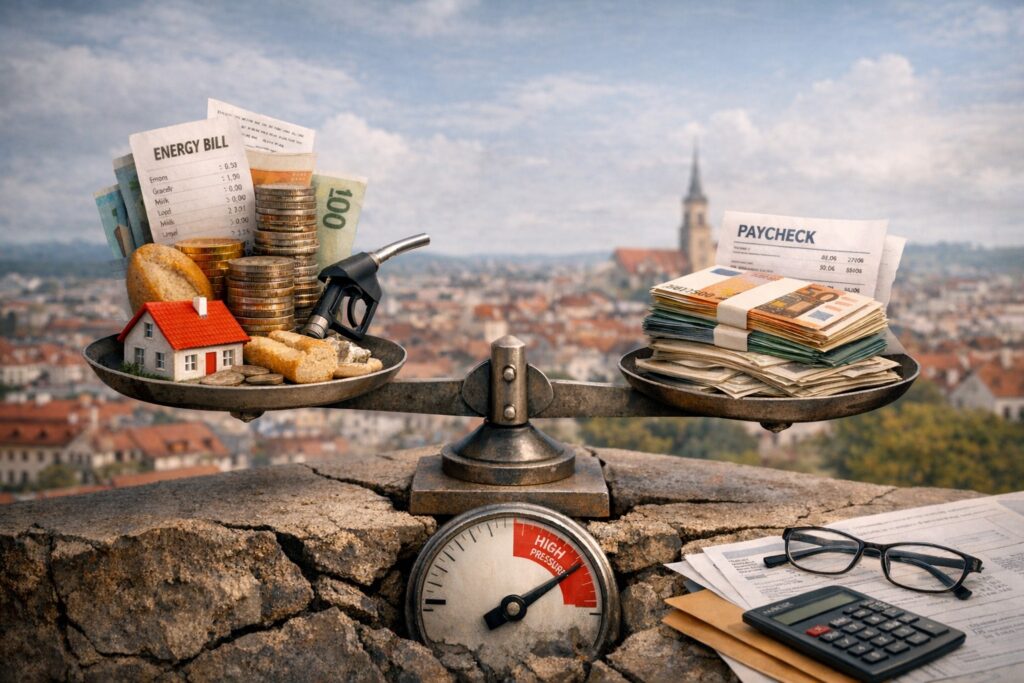


Most people think the cost of daily life in Europe is defined by the big numbers. Rent. Taxes. Energy bills. But daily budgets rarely collapse because of one large expense.
They change because of everything else.
Disclaimer
This article is provided for informational and comparative purposes only. Price and income figures referenced throughout the analysis are based on publicly available datasets, including Eurostat statistics, European Commission energy and fuel price data, and aggregated market estimates such as Numbeo. Actual household spending can vary significantly depending on location, household structure, consumption patterns, and changing market conditions. The analysis reflects indicative benchmarks rather than precise household budgets and should not be interpreted as financial or policy advice.
Introduction
At first glance, the cost of daily life in Europe rarely looks dramatic.
Most people notice the big expenses first. Rent dominates the conversation. Energy bills receive headlines whenever prices rise. Salary comparisons usually revolve around annual income.
But the real pressure on household budgets often appears somewhere else.
In everyday spending.
Groceries that cost slightly more each week.
Public transport passes that quietly renew every month.
Fuel purchases that barely register individually but accumulate over time.
None of these expenses looks decisive on its own.
That’s the trap.
Across the European Union, small recurring costs interact with income levels, taxation structures, and local price differences in ways that many people underestimate. Individually they seem manageable. Together they reshape how much disposable income actually remains at the end of the month.
This is why discussions about the cost of living in Europe can sometimes miss the real arithmetic. Housing is important — but daily spending is what quietly determines how far an income actually stretches.
For the full category-by-category framework, see Cost of Living in Europe 2026: A Complete Breakdown by Category.
And this is where things become interesting.
Because once groceries, utilities, mobility and everyday purchases are examined together, the financial picture of daily life in Europe begins to look very different from what the headline numbers suggest.
The Invisible Layer of Spending
Large expenses are easy to recognise.
Rent appears in one transaction.
Energy bills arrive as a single number.
Taxes are deducted before income even reaches your bank account.
Daily spending behaves differently.
It is fragmented.
A coffee before work.
A small grocery purchase in the evening.
A transport ticket, a streaming subscription, a quick takeaway.
None of these costs looks decisive at the moment it happens. Most are measured in single digits or low double digits. And because they are spread across the month, they rarely trigger the same psychological reaction as a large bill.
This is where the cost of daily life in Europe begins to accumulate faster than expected.
Consider a simple example. Spending €15–€20 a day on small purchases — coffee, lunch, transport, or minor shopping — does not feel unusual in most European cities.
But the arithmetic is simple.
€20 per day becomes roughly €600 per month.
Over a year, that approaches €7,000.
Simple.
And that figure appears before rent, utilities, or larger purchases even enter the picture.
This compounding effect is often overlooked when people compare the cost of living in Europe. Major expenses dominate the discussion, but everyday consumption quietly shapes the monthly outcome.
It is not one purchase that changes the budget.
It is repetition.
And once those repeated costs are layered together with groceries, energy, and mobility, the structure of daily spending begins to look very different from the initial estimate.

Groceries: Small Increases, Large Budgets
Food spending rarely looks dramatic on a single receipt.
A few euros more for vegetables.
A slightly higher price for meat or dairy.
A grocery basket that feels only marginally more expensive than last month.
But groceries are one of the most persistent components of the cost of daily life in Europe. Unlike rent or utilities, they repeat continuously — week after week, month after month.
For a deeper food-cost comparison, see Grocery Prices in Europe 2026: Where Does a Monthly Food Basket Take the Biggest Bite of Your Salary?.
Using a standardised one-person grocery basket built from typical staples — milk, eggs, bread, rice, meat and fresh fruit and vegetable — monthly grocery costs across the EU generally fall between €120 and €260 depending on the country.
At first glance, that does not look extraordinary.
What matters is the share of income.
In several higher-income economies such as Ireland, the Netherlands or Denmark, the same basket typically represents around 5–7% of average monthly net income. Stronger wage levels soften the relative impact of higher nominal food prices.
In parts of Central and Eastern Europe, however, the ratio shifts. Even where nominal grocery prices are lower, the basket can absorb 10–14% of average income under the same benchmark.
This difference is structural.
Food markets across Europe are deeply integrated through supply chains, agricultural production and cross-border trade. As a result, price dispersion is narrower than in housing markets. Yet income levels vary significantly between member states, which means the same grocery bill carries very different economic weight.
This interaction is easy to overlook in daily life.
A single grocery purchase rarely feels decisive. But over a month — or a year — the cumulative cost becomes one of the largest recurring elements of the household budget.
And unlike rent, groceries do not stay fixed.
They move constantly.
Which means they quietly reshape the cost of daily life in Europe even when the change appears small on any individual shopping trip.
Utilities: The Background Cost That Never Disappears
Energy bills behave differently from most everyday expenses.
They are not paid every day like groceries, and they are not as visible as rent. But once they enter the household budget, they rarely shrink to zero.
Across the European Union, electricity and gas prices vary widely between countries. According to Eurostat’s latest harmonised data for 2024, household electricity prices range from roughly €0.10 per kilowatt-hour in some member states to nearly €0.40 in others. Gas prices show a similarly wide dispersion.
For the full electricity-and-gas comparison, see Europe Utility Costs: Electricity and Gas Compared Across the EU-27 (Taxes Included).
At first glance, those differences appear modest — just a few cents per unit.
But once consumption enters the equation, the numbers change quickly.
Using a standardised benchmark of 3,500 kWh of electricity and 11,000 kWh of natural gas per year, estimated monthly energy costs vary significantly across the EU. In higher-income economies such as Luxembourg or Ireland, electricity and gas together represent roughly 3–5% of average monthly net income under this benchmark.
In several other member states — including Czechia, Portugal and Latvia — the combined burden can exceed 10% of income.
That gap matters.
Utilities sit underneath almost every other expense. Heating, lighting, cooking, hot water — the basic infrastructure of daily life runs through energy consumption. Even when price levels look manageable in nominal terms, lower income levels can amplify their relative weight in the household budget.
And because energy bills recur month after month, they quietly reinforce the overall cost of daily life in Europe.
Not the largest line item.
But one that never really disappears.
Transport and Fuel: Mobility Has a Price
Mobility is another cost that rarely feels dramatic in the moment.
A train ticket here.
A metro pass there.
A tank of fuel every week or two.
Individually, none of these purchases looks large enough to reshape a monthly budget. But transport expenses are constant — and that repetition makes them a meaningful component of the cost of daily life in Europe.
Fuel prices alone illustrate how quickly the arithmetic changes.
For an income-adjusted fuel comparison, see Fuel Prices in Europe: Petrol and Diesel Compared Across the EU-27 (Income-Adjusted Analysis).
Based on the European Commission’s Weekly Oil Bulletin, average petrol prices across the EU in 2025 range from roughly €1.30 per litre in some member states to almost €2.00 in others. Diesel prices follow a similar pattern.
At first glance, a difference of €0.50 per litre does not appear dramatic.
But once consumption is applied, the impact becomes clearer.
Under a simple benchmark of 60 litres per month, that €0.50 difference translates into roughly €30 more each month. If the gap reaches €0.70 per litre, the difference approaches €40–€45 per month.
Over the course of a year, that becomes several hundred euros.
And income levels matter just as much as prices.
In higher-income economies such as Luxembourg, Ireland or the Netherlands, a typical 60-litre monthly purchase represents roughly 2–3% of average net income. In several Central and Eastern European countries, the same purchase can absorb 7–8% of income under the same benchmark.
That shift illustrates an important point.
The nominal price at the pump does not determine the economic burden on its own. Retail fuel costs reflect taxation structures, wholesale markets, distribution logistics, and exchange-rate dynamics — but the relative pressure ultimately depends on local wage levels.
Like groceries and utilities, fuel rarely arrives as one large bill.
Instead it appears in smaller, repeated purchases that quietly reinforce the overall cost of daily life in Europe.
And over time, those small purchases add up.

The €20-a-Day Effect
This is where the arithmetic becomes surprisingly simple.
And surprisingly large.
Most people think of daily spending as minor — a coffee, a quick lunch, a ride across town, something small from a supermarket on the way home. None of these purchases feels particularly expensive.
But the cost of daily life in Europe often grows through repetition rather than through large transactions.
Consider a very ordinary example.
A €3 coffee in the morning.
A €10 lunch during the workday.
A €5–€7 transport or small purchase later in the day.
That already approaches €20 per day in everyday spending.
Individually, the purchases look harmless. They do not trigger the same reaction as rent or a large utility bill.
But the monthly arithmetic is straightforward.
€20 per day becomes roughly €600 per month.
Over a full year, that approaches €7,200.
That number surprises many people the first time they see it.
Of course, not every household spends exactly €20 each day. Some spend less, others more. But the principle remains the same: small recurring expenses accumulate faster than expected when they repeat every day.
This compounding effect is one of the most underestimated drivers of the cost of living in Europe.
Large expenses dominate attention because they appear in one visible payment. Daily expenses operate differently — they spread across dozens of small transactions that rarely look significant on their own.
Until the end of the month arrives.
And the total becomes clear.
Subscriptions and the Digital Layer
A decade ago, many everyday services were one-time purchases.
Today, they are subscriptions.
Music, films, cloud storage, software, fitness apps, delivery services — an increasing share of modern consumption operates on recurring monthly payments. Individually, these costs rarely look large.
€9.99 for a streaming platform.
€12 for music.
€3 or €5 for an app upgrade.
Small numbers.
But the subscription economy has quietly added another layer to the cost of daily life in Europe.
It happens gradually.
One service appears essential. Another is bundled with a device. A third offers convenience — automatic deliveries, faster shipping, or access to digital tools used every day.
Before long, many households find themselves paying €50 to €100 per month across multiple subscriptions without noticing the cumulative effect.
And unlike groceries or transport, these expenses often operate in the background.
They renew automatically.
No decision is made each month. The payment simply reappears on the statement. Over time, these recurring micro-payments become a stable component of everyday spending — small enough to ignore, large enough to matter.
This shift is one of the more subtle changes in modern household budgets.
The traditional drivers of the cost of living in Europe — housing, food, and utilities — remain central. But digital services have created a parallel layer of recurring expenses that did not exist in the same form two decades ago.
Individually, they are modest.
Collectively, they become another permanent line in the monthly budget.
This convenience layer is explored further in The Real Cost of Convenience in European Cities (And Why It Adds Up Fast).
Why Europe’s Cost Structure Feels Different
Another factor quietly shaping the cost of daily life in Europe is the structure of prices themselves.
Across most EU member states, the price consumers see already includes tax. Value-added tax (VAT) is embedded in the final retail price of many goods and services, often at rates between 20% and 25%.
That means the cost of everyday purchases already carries a significant tax layer.
A restaurant meal, a train ticket, a pair of shoes, a digital subscription — each transaction typically includes VAT within the displayed price. Consumers rarely see the tax component directly, but it forms part of the final amount paid.
This structure differs from some other regions where taxes are added at checkout rather than included in the sticker price.
The result is subtle but important.
Every small purchase — groceries, mobility, services — carries a built-in fiscal component. Individually it may appear marginal, but across hundreds of transactions over a month or a year, it becomes part of the broader economic structure that shapes everyday spending.
This does not mean daily life in Europe is uniquely expensive.
But it does mean that the cost of daily life in Europe reflects a layered system of prices, taxation, and public services. Higher taxes often correspond to publicly funded healthcare, education, and infrastructure — elements that influence household budgets in different ways.
Still, for day-to-day spending, the effect is straightforward.
Every transaction carries a little more weight.
And over time, those small increments accumulate across the entire household budget.
Why Small Costs Escalate So Quickly
Here’s the part many people underestimate.
Large expenses are predictable. Rent arrives once a month. Utilities arrive every billing cycle. These payments are visible, planned, and usually tracked.
Small costs behave differently.
They repeat constantly.
Groceries several times a week.
Transport almost every day.
Coffee, lunch, small purchases, digital services.
Each transaction is minor. But frequency changes the mathematics.
And this is where the cost of daily life in Europe quietly accelerates.
Consider a simple monthly structure under a very typical scenario:
- Groceries: €180–€250
- Utilities (electricity and gas benchmark): €120–€200
- Fuel or transport costs: €90–€120
- Subscriptions and digital services: €40–€80
- Daily small purchases: €300–€600
Individually, none of these items seems dramatic.
Together, however, they can easily reach €700 to €1,200 per month before housing costs even enter the calculation.
This is one reason Why Saving Money Feels Harder — Even When Your Income Is Stable.
That’s the key point.
Housing still dominates the cost of living in Europe, but daily expenses form the second layer — the one that shapes how much money actually remains at the end of each month.
And unlike rent, these costs are fluid. They move with consumption habits, local price levels, energy markets, and inflation.
Which means their cumulative impact often becomes visible only when the full monthly budget is added up.
Not when each purchase is made.
The Quiet Budget Pressure
Put all of these layers together and a pattern becomes clear.
Housing may dominate the conversation about the cost of daily life in Europe, but everyday spending is what determines how comfortable that life actually feels.
Rent is fixed.
Daily expenses are cumulative.
Groceries repeat every week. Energy bills arrive every month. Transport, fuel, and small purchases appear continuously. Digital subscriptions renew automatically in the background.
None of these costs feels extraordinary on its own. Yet combined, they form the second-largest component of the household budget across much of Europe.
And here’s what’s interesting.
Because these expenses are fragmented — spread across dozens of payments — they rarely receive the same attention as large, single bills. Most people remember their rent immediately. Far fewer can estimate how much they spend each month on groceries, subscriptions, fuel, and small daily purchases combined.
But the arithmetic is real.
Under fairly typical consumption patterns, everyday spending can easily reach €800 to €1,200 per month in many European economies before rent is even considered.
That does not automatically imply financial pressure.
In higher-income economies, those costs may remain manageable relative to earnings. In others, they can represent a much larger share of disposable income.
Either way, the conclusion is the same.
The cost of daily life in Europe is shaped less by one dramatic expense than by the steady accumulation of many small ones.
And that accumulation is easy to overlook — until the monthly totals appear.
Conclusion
Daily life rarely becomes expensive all at once.
It becomes expensive gradually.
A grocery receipt here.
A utility bill there.
Fuel, transport, subscriptions, small purchases during the day.
Individually, each cost looks manageable. But together they form the everyday economic structure that shapes the cost of daily life in Europe.
The data across the EU-27 show a consistent pattern. Energy prices vary significantly between countries. Fuel prices differ depending on taxation and market structure. Grocery costs are relatively similar across the Union — yet income levels determine how heavy those costs feel.
This interaction is what many people overlook.
Nominal prices alone do not define the real burden of daily expenses. The same grocery bill or fuel purchase can represent a very different share of income depending on where someone lives.
And that difference compounds over time.
Because daily expenses repeat constantly. They do not arrive as a single payment, but as dozens of small transactions that accumulate across weeks and months.
That is why the cost of daily life in Europe often grows faster than expected.
Not because of one dramatic price.
But because everyday spending adds up — quietly, consistently, and often unnoticed until the full monthly budget is calculated.
Key Takeaways
- The cost of daily life in Europe is shaped primarily by recurring expenses rather than one-off purchases.
- Grocery costs across the EU-27 typically range between €120 and €260 per month for a single adult under a standardised basket benchmark.
- Electricity and gas together can represent 3% to over 10% of monthly income depending on price levels and national earnings.
- Fuel prices across Europe vary significantly, with petrol averaging roughly €1.30 to €2.00 per litre across member states in 2025.
- Small daily purchases can accumulate quickly — even €20 per day equals roughly €600 per month.
- Subscriptions and digital services have added a new recurring layer to household budgets.
- Price levels alone do not determine affordability. Income differences across EU countries significantly affect the relative burden of everyday expenses.
- Because these costs are fragmented across many small transactions, their cumulative impact is often underestimated.
Methodology & Sources
This analysis combines harmonised European statistical datasets with standardised consumption benchmarks to illustrate how everyday expenses accumulate within the broader cost of daily life in Europe.
The objective is comparative insight rather than household budgeting guidance.
Income Benchmark
Income comparisons use the following Eurostat dataset:
Eurostat — Annual Net Earnings (earn_nt_net)
Parameters applied:
- Earnings structure: Net earnings
- Earnings case: Single person without children
- Income level: 100% of the national average wage
- Employment status: Full-time
- Reference year: 2024
- Currency: Euro
Annual net earnings are divided by 12 to obtain monthly benchmarks used for cross-country comparisons.
This dataset provides a standardised after-tax income model, allowing meaningful comparison across EU member states despite differences in tax systems.
The figures do not represent median income, household income, or sector-specific wages.
Electricity Prices
Electricity prices are sourced from:
Eurostat — Electricity prices for household consumers (dataset: nrg_pc_204)
Parameters used:
- Consumption band: DC (2,500–4,999 kWh)
- Unit: € per kWh
- Price level: Including all taxes and levies
- Time frequency: Bi-annual
The 2024 annual value is calculated as the arithmetic average of:
- 2024-S1
- 2024-S2
Estimated monthly electricity cost benchmark:Electricity Price×3,500 kWh÷12
The 3,500 kWh annual consumption is a standardised reference assumption used to allow cross-country comparability.
Natural Gas Prices
Gas prices are sourced from:
Eurostat — Gas prices for household consumers (dataset: nrg_pc_202)
Parameters used:
- Consumption band: D2 (20–199 GJ)
- Unit: € per kWh
- Price level: Including all taxes and levies
- Time frequency: Bi-annual
The 2024 annual value represents the average of 2024-S1 and 2024-S2.
Estimated monthly gas cost benchmark:Gas Price×11,000 kWh÷12
The assumed 11,000 kWh annual gas consumption (≈39.6 GJ) falls within the Eurostat D2 band, ensuring methodological alignment.
Grocery Cost Benchmark
Grocery estimates use a standardised monthly food basket built from common staple categories.
Prices are sourced from:
Numbeo — Cost of Living Database (2026 snapshot)
The basket includes:
- Milk
- Eggs
- Bread
- Rice
- Chicken
- Beef
- Cheese
- Apples
- Bananas
- Oranges
- Tomatoes
- Potatoes
- Onions
- Lettuce
Monthly basket costs across EU countries typically range between €120 and €265 depending on national price levels.
The basket serves as a comparative benchmark rather than a nutritional guideline or representation of national diets.
Fuel Prices
Fuel price data are sourced from:
European Commission — Weekly Oil Bulletin (DG Energy)
Parameters used:
- Retail prices including duties and taxes
- Fuel types:
- Euro-super 95 (petrol)
- Automotive gas oil (diesel)
- Reported in €/1000 litres and converted to €/litre
- 2025 annual averages calculated from weekly data
Monthly fuel expenditure benchmark:Fuel Price×60 litres
The 60-litre monthly benchmark serves as a simplified reference level for comparative analysis.
Consumption Assumptions
To illustrate the cumulative structure of everyday expenses, the analysis applies the following standardised consumption assumptions:
- Electricity: 3,500 kWh per year
- Natural gas: 11,000 kWh per year
- Fuel: 60 litres per month
- Groceries: standardised one-person monthly basket
These assumptions do not represent national averages or specific household profiles.
They are used solely to enable consistent cross-country comparison.
Scope & Limitations
This framework is designed to illustrate structural drivers behind the cost of daily life in Europe, not to estimate individual household budgets.
The analysis does not account for:
- Household size or dual-income households
- Differences in housing costs or mortgage structures
- Dwelling size, insulation quality, or heating technology
- Climate differences and regional energy consumption
- Vehicle ownership rates or commuting distance
- Public transport substitution
- Promotional grocery pricing or discount retailers
- Behavioural variation in spending patterns
Observed prices may include regulated tariffs, temporary price caps, subsidies, or tax adjustments reflected in official datasets during the reporting period.
Accordingly, the figures presented should be interpreted as comparative indicators of structural cost pressure, rather than precise measures of household expenditure.
Editorial Disclaimer
The information presented in this article is provided for informational and comparative purposes only. Prices, income benchmarks, and market conditions across Europe are subject to change and may change materially over time due to inflation, taxation, regulation, energy markets, retail pricing, and broader economic conditions.
All figures referenced in this analysis are based on publicly available datasets and market snapshots available at the time of publication. As a result, they should be interpreted as indicative benchmarks rather than fixed or permanent price levels.
Finorum does not guarantee that all data will remain current after publication and accepts no responsibility for decisions made on the basis of this article or for any misinterpretation of the information presented. Readers should verify current prices, local conditions, and their own financial circumstances before relying on comparative cost estimates.
Sources
Primary data sources used in this analysis:
Eurostat — Annual Net Earnings
Dataset: earn_nt_net
Indicator: Net annual earnings of a single person without children earning 100% of the national average wage
Reference year: 2024
Eurostat — Electricity Prices for Household Consumers
Dataset: nrg_pc_204
Consumption band: DC (2,500–4,999 kWh)
Prices include all taxes and levies
Reference period: 2024-S1 and 2024-S2
Eurostat — Gas Prices for Household Consumers
Dataset: nrg_pc_202
Consumption band: D2 (20–199 GJ)
Prices include all taxes and levies
Reference period: 2024-S1 and 2024-S2
European Commission — Weekly Oil Bulletin
Directorate-General for Energy
Indicator: Retail fuel prices including duties and taxes
Fuel types: Euro-super 95 (petrol) and automotive diesel
Reference period: 2025 annual averages of weekly prices
Numbeo — Cost of Living Database
Indicator: National grocery price averages
Used to construct the Finorum standardised monthly grocery basket
Data snapshot: 2026
Data accessed: March 2026
All calculations apply harmonised benchmarks to allow cross-country comparison across EU-27 member states.
FAQ: The Cost of Daily Life in Europe
Why does daily life feel expensive in Europe even when salaries seem reasonable?
Daily expenses accumulate through repetition. Groceries, energy bills, transport, and small daily purchases occur frequently, which means their combined monthly impact can be larger than expected.
Across many EU countries, these recurring costs together can reach €700–€1,200 per month before housing is even considered. That is why the cost of daily life in Europe often feels higher than individual price tags suggest.
How much do groceries typically cost in Europe per month?
Under a standardised one-person grocery basket, food costs across the EU usually range between €120 and €265 per month depending on the country.
Higher-income economies often show higher nominal prices, but the grocery cost relative to income is typically lower due to stronger wage levels. In lower-income countries, even moderate grocery prices can represent a larger share of monthly earnings.
How much do electricity and gas cost in Europe?
Using a harmonised benchmark of 3,500 kWh electricity and 11,000 kWh gas per year, estimated monthly household energy costs across the EU vary significantly.
In higher-income countries such as Luxembourg or Ireland, utilities often represent around 3–5% of average net income. In several other EU member states, the same benchmark can exceed 10% of income, depending on price levels and wages.
Why are energy prices so different across European countries?
Electricity and gas prices vary due to several structural factors, including:
national taxation and levies
energy mix (renewables, nuclear, gas, imports)
network infrastructure costs
regulatory frameworks and price caps
Because these elements differ across member states, household energy prices can vary significantly even within the EU single market.
How much do people spend on fuel in Europe?
Based on 2025 annual average fuel prices, petrol across the EU generally ranges between €1.30 and €2.00 per litre.
Using a simple benchmark of 60 litres per month, fuel spending typically ranges between €80 and €120 per month depending on national price levels.
When adjusted for income, this represents roughly:
2–3% of average net income in several higher-income countries
6–8% of income in parts of Central and Eastern Europe
Why do small daily expenses add up so quickly?
Small purchases repeat frequently. A coffee, lunch, transport ticket, or small retail purchase may only cost a few euros, but over time the cumulative impact becomes significant.
For example:
€20 per day in daily spending equals roughly €600 per month
Over a year, that reaches €7,200
This compounding effect is one of the most underestimated drivers of the cost of living in Europe.
Are everyday expenses higher in Western Europe than in Eastern Europe?
Nominal prices are often higher in Western and Northern Europe, but income levels are also higher.
In several Central and Eastern European countries, prices for groceries, energy, or fuel may be lower in absolute terms. However, because wages are lower, the income-adjusted burden of daily expenses can sometimes be higher.
Affordability therefore depends on both price levels and earnings.
What are the biggest hidden costs of daily life in Europe?
Beyond housing, the most common recurring expenses include:
groceries
electricity and gas
transport and fuel
digital subscriptions
small daily purchases (coffee, lunch, retail)
These categories together form the second major layer of the cost of daily life in Europe, often reaching €800–€1,200 per month under typical spending patterns.
Is the cost of living in Europe rising?
Price levels across Europe have increased in recent years due to inflation, energy market volatility, and supply-chain pressures. While inflation rates fluctuate over time, the baseline price level for many everyday goods and services remains higher than before 2020.
This means households often feel higher daily expenses even when short-term inflation slows.
Iva Buće is a Master of Economics specializing in digital marketing and logistics. She combines analytical thinking with creativity to make financial and investment topics accessible to a broader audience. At Finorum, she focuses on translating complex economic concepts into clear, practical insights for everyday readers and investors.