

Income vs Cost of Living in Europe is not just a comparison of price levels. It’s a question of how much financial room households actually have once the essentials are paid.
Disclaimer
This article is provided for informational and educational purposes only. It does not constitute financial, investment, legal or tax advice. The analysis is based on publicly available Eurostat data and reflects aggregate national indicators. It does not account for individual financial circumstances, regional differences or household-specific conditions. All data are presented as reported in the latest available releases at the time of writing. Statistical revisions may occur. Readers should conduct their own research or consult qualified professionals before making financial decisions.
Introduction
Berlin is generally more expensive than Bucharest by most price-level measures, including consumer price and housing indices.
But that alone does not tell us where financial pressure is actually higher.
Public debates about cost of living in Europe tend to focus on prices — rent, groceries, fuel. Those figures are visible and easy to compare. Yet price levels, taken in isolation, say very little about financial strain unless they are assessed alongside income data.
That is where the picture becomes more complex.
Recent Eurostat data show a substantial gap in disposable income per capita between higher-income economies such as Germany and lower-income economies such as Romania (measured in purchasing power standards). The difference is structural, not marginal.
But disposable income is only the starting point. The real question is what remains after core expenses — especially housing — and how large a buffer households can realistically build.
Because financial pressure is not defined by how high prices are.
It is defined by how much room is left after the basics are paid.
The Income Gap Is Real — But Not the Whole Story
Income differences across Europe are not incremental. They are structural.
The latest available Eurostat national accounts data show that adjusted gross disposable income per capita (in purchasing power standards, PPS) ranges from just above 37,000 in Germany to around 23,000 in Hungary. The Netherlands and France remain comfortably above 32,000, while Poland stands close to 23,500.
That spread reflects different economic tiers operating within the same single market.

But income alone does not define financial pressure.
Disposable income — even when adjusted for purchasing power — captures what households receive after taxes and transfers. It does not show how that income is absorbed by essential expenditure. Nor does it indicate how much capacity remains for savings once core costs are covered.
To assess that structure more precisely, the table below combines the latest available Eurostat indicators — primarily reflecting the 2023 income reference year — drawn from different statistical domains (EU-SILC and national accounts).
Income vs Spending Structure — Latest Available Eurostat Data
(primarily 2023 income reference year; multiple statistical domains)
| Country | Income (PPS) | Food Share | Housing Overburden | Saving Rate |
|---|---|---|---|---|
| Germany | 37,098 | 11.2% | 12.0% | 20.0% |
| Netherlands | 34,406 | 11.3% | 6.9% | 16.6% |
| France | 32,371 | 12.1% | 7.0% | 17.9% |
| Denmark | 29,268 | 11.8% | 14.6% | 14.3% |
| Italy | 28,646 | 14.7% | 5.1% | 12.0% |
| Spain | 26,999 | 12.4% | 7.8% | 12.7% |
| Poland | 23,567 | 18.1% | 5.2% | 7.8% |
| Hungary | 22,933 | 16.8% | 9.0% | 18.6% |
Several patterns emerge.
Higher-income economies generally allocate a smaller share of total consumption to food, while maintaining stronger aggregate saving rates. Germany, the Netherlands and France all combine relatively low food shares (around 11–12%) with double-digit saving rates.
But the contrast is not binary.
Hungary, despite a significantly lower income level than Western Europe, records a comparatively high aggregate saving rate. At the same time, food absorbs nearly 17% of total consumption — materially higher than in Germany or the Netherlands. That suggests tighter spending structures even where macro-level savings remain positive.
Housing pressure adds another layer. Denmark shows a relatively elevated housing overburden rate, reflecting the share of households spending more than 40% of disposable income on housing. Yet its aggregate saving rate remains solid. Italy, by contrast, records a low overburden rate but also a more modest saving rate.
These indicators operate at different statistical levels — some distributional (EU-SILC), others macro-aggregated (sector accounts). Taken together, however, they reveal something structural.
Financial resilience in Europe is not determined by income alone. It depends on how income interacts with spending composition — and whether households retain enough margin to build buffers over time.
Food as the Structural Signal
Income levels explain capacity.
Food expenditure reveals constraint.
Across the eight countries in our comparison, the share of total household consumption spent on food ranges from just above 11% in Germany and the Netherlands to nearly 17% in Hungary. Poland stands above 18%, while Italy sits close to 15%.
That spread is not cultural. It is structural.
Economists describe this dynamic through Engel’s Law: as income rises, the proportion of spending devoted to basic necessities declines. Households may spend more in absolute terms, but the share of the budget falls.
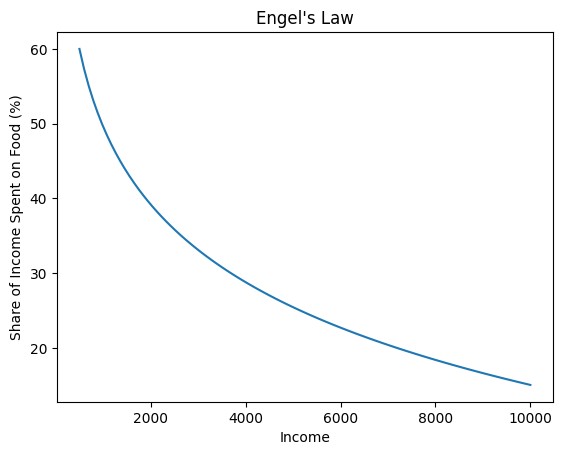
The data follow that pattern closely.
We can make it tangible.
If a household has the equivalent of 3,000 (in PPS-adjusted terms) and spends 350 on food, that absorbs a modest share of total resources. If another household operates on 1,800 and spends 300, the grocery bill looks similar in absolute terms — but its weight inside the budget is materially heavier.
That difference shapes behaviour.
Public debates often label Central and Eastern Europe as “cheaper” and Western Europe as “expensive.” At the level of price tags, that may hold. But when food absorbs 17–18% of total consumption, as in Hungary and Poland, the room for discretionary spending narrows much faster than in economies where the share is closer to 11%.
And that narrowing matters.
It determines how easily households can absorb energy price volatility. It influences whether savings can be accumulated consistently. It affects pension contributions, financial asset ownership, even relocation decisions.
Importantly, food share here is measured as a percentage of total household consumption expenditure under the COICOP classification (national accounts). It does not imply that food prices are higher in lower-income economies. It indicates that income levels compress the spending structure.
The alignment is clear.
Higher-income economies display lower food shares and stronger saving rates. Lower-income economies show higher shares and tighter margins. The relationship is not mechanical — but it is persistent.
Simple. Structural. Difficult to ignore.
Housing: Where the Real Divide Appears
Food shapes daily budgets.
Housing shapes long-term stability.
Across the countries in our comparison, the housing cost overburden rate — defined as the share of households spending more than 40% of disposable income on housing — varies meaningfully.
Denmark and Germany show relatively elevated overburden rates. Italy and Poland sit lower. Hungary falls closer to the middle of the range. At first glance, that may seem counterintuitive. Shouldn’t higher-income countries show less pressure?
Not necessarily.
The overburden indicator is distributional. It tells us how many households cross a statistical stress threshold. It does not measure average rent levels, nor does it capture wealth or accumulated assets. A country with high urban rents and a large rental sector may show higher overburden even if aggregate incomes are strong.
That distinction is important.
Germany combines a comparatively high housing overburden rate with a saving rate above 20%. Denmark shows a similar configuration: visible housing pressure alongside a solid aggregate saving position. In other words, housing can be expensive — even stressful for segments of the population — without eliminating macro-level saving capacity.
Hungary presents a different structure. Income per capita is materially lower than in Western Europe. Food absorbs a larger share of consumption. Yet the aggregate saving rate remains comparatively high in the latest annual data. That suggests a tighter spending structure, but not one without buffer.

Italy and Spain offer another variation: moderate incomes, lower overburden rates, and mid-range saving levels — suggesting less visible housing stress, but also more limited aggregate buffers.
And here is the nuance.
A low overburden rate does not automatically signal affordability. It may reflect high ownership rates, family co-residence patterns, or different housing finance structures. Likewise, a high overburden rate does not mean an economy is fragile — it may reflect rental market dynamics concentrated in major urban centres.
Housing, in short, is not just a price story.
It is an institutional story.
Rental markets, mortgage penetration, ownership structures, and urbanisation patterns shape how income translates into lived pressure. Two countries can display similar disposable income levels and very different housing stress profiles.
Which brings us back to the central question.
Resilience is not determined by a single indicator. It emerges from how income, spending composition and saving capacity interact over time.
Housing is where those forces meet.
The Buffer Effect: Why Saving Rates Change the Entire Picture
Income explains earning power.
Spending explains structure.
Saving explains resilience.
Across the countries in our comparison, household saving rates range from around 7–8% in Poland to above 20% in Germany. France and the Netherlands sit comfortably in the mid-to-high teens. Italy and Spain remain in the low double digits. Hungary, despite lower income levels, records a comparatively high aggregate saving rate in the latest annual data.
That dispersion is not cosmetic. It changes how economies absorb shocks.
A household system that saves 15–20% of disposable income has room to adjust. Energy prices rise — spending can be smoothed. Labour income falls temporarily — buffers exist. Interest rates increase — debt servicing can be managed.
When saving rates are materially lower, the adjustment mechanism is narrower.

And here’s what many overlook.
Saving rate is not just about prudence. It reflects structural capacity. Higher-income economies can sustain lower food shares, absorb higher housing costs, and still retain surplus income. Lower-income economies often face tighter trade-offs: essential consumption absorbs a larger share, leaving less flexibility even if headline price levels appear moderate.
This is why simple “cheap versus expensive” comparisons are misleading.
A country can have moderate rents and moderate grocery prices — and still operate with limited aggregate buffers. Another can face high housing costs and still maintain macro-level resilience.
Saving rates do not tell us everything. They are aggregates. They mask inequality within countries. They fluctuate with the cycle.
But they reveal something critical.
They show whether, at the system level, income exceeds essential expenditure by a comfortable margin — or only barely.
That margin is the difference between stability and fragility.
And it is often invisible in standard cost-of-living debates.
Conclusion
Europe is not divided simply into “expensive” and “cheap” countries.
It is divided by structure.
Higher-income economies tend to absorb high housing costs while maintaining double-digit saving rates. Lower-income economies may face lower absolute prices, yet allocate a larger share of income to essentials — leaving less margin for flexibility.
That margin is the real dividing line.
Price levels matter. Income levels matter. But what ultimately determines financial resilience is the interaction between the two — and whether households retain enough surplus to build buffers over time.
Two countries can look similar on a supermarket receipt and very different on a balance sheet.
Cost-of-living debates often stop at price comparisons. The more relevant question is harder to see: how much room is left once the basics are covered.
That is where economic tiers become visible.
Key Takeaways
- Income levels across the EU remain structurally different, even when adjusted for purchasing power.
- Food expenditure share is a reliable signal of constraint. Higher shares typically indicate tighter household budgets, not necessarily higher prices.
- Housing overburden measures distributional stress, not average rent levels. Institutional factors — rental markets, ownership structures, urbanisation — matter.
- Saving rates are a proxy for macro-level resilience. Higher aggregate saving provides economies with greater shock-absorption capacity.
- Affordability is about margins, not price tags. The critical variable is how much income remains after essential spending.
Data & Methodology
This article draws on the latest available annual Eurostat data (accessed February 2026). The indicators used originate from different statistical domains and are combined for structural comparison purposes.
The following datasets were used:
- Adjusted gross disposable income of households per capita (PPS, current prices) — National accounts (ESA 2010), dataset code: tec00113
Income is expressed in purchasing power standards (PPS) to ensure cross-country comparability. Figures primarily reflect the 2023 reference year, as reported in the latest annual national accounts release. - Housing cost overburden rate — EU-SILC, dataset code: tespm140
Defined as the share of households spending more than 40% of disposable income on housing costs. Distributional indicator based on survey data. - Household final consumption expenditure by purpose (COICOP 2018 classification) — National accounts, dataset code: nama_10_cp18
Food and non-alcoholic beverages expressed as a percentage of total household final consumption expenditure. - Household saving rate (gross) — Sector accounts, dataset code: tec00131
Gross household saving rate, expressed as a percentage of gross disposable income. Annual data.
The selected countries (Germany, Netherlands, France, Denmark, Italy, Spain, Poland, Hungary) represent different income tiers within the EU for structural comparison. The analysis does not attempt to measure intra-country inequality or regional disparities.
Indicators from EU-SILC (distributional survey data) and national accounts (aggregate macroeconomic data) operate at different statistical levels and are combined here to illustrate structural differences in household financial resilience.
All figures refer to the latest annual data available at the time of writing. Minor revisions may occur as Eurostat updates its datasets.
FAQ — Income vs Cost of Living in Europe
Is Eastern Europe really cheaper to live in?
In terms of absolute price levels, many Central and Eastern European countries have lower consumer prices than Western Europe.
But affordability depends on income. When a larger share of total household consumption goes toward essentials like food, even lower prices can translate into tighter budgets.
Lower prices do not automatically mean greater financial flexibility.
What is the housing cost overburden rate?
The housing cost overburden rate measures the percentage of households spending more than 40% of their disposable income on housing costs.
It is a distributional indicator used by Eurostat (EU-SILC). A higher rate signals that a larger share of households crosses a financial stress threshold — but it does not measure average rent levels.
Why is food expenditure share important in cost-of-living comparisons?
Food share reflects how much of total household consumption is devoted to basic necessities.
According to long-established economic theory (Engel’s Law), lower-income households typically spend a higher proportion of their budget on food. A higher food share often signals tighter financial margins, even if prices themselves are moderate.
It is a structural indicator of constraint.
Which EU countries save the most?
Household saving rates vary significantly across the EU. Countries such as Germany and France tend to report higher aggregate saving rates, while others operate with narrower margins.
Saving rates are based on sector accounts data and represent macro-level behaviour — not individual outcomes — but they provide insight into overall financial resilience.
Does a high cost of living always mean lower quality of life?
Not necessarily.
High-income economies can sustain high housing and consumer prices while maintaining strong saving capacity. Conversely, lower-income economies may have lower absolute prices but less financial buffer.
Quality of life depends on income levels, public services, housing systems and economic structure — not just price tags.
What is the difference between disposable income and median income?
Disposable income per capita (national accounts) measures total household income after taxes and transfers divided by population.
Median equivalised income (EU-SILC) reflects the income of the “middle” household, adjusted for household size.
They serve different analytical purposes. This article uses national accounts disposable income in purchasing power standards (PPS) for cross-country comparability.
How should cost of living in Europe really be compared?
The most meaningful comparisons combine:
Disposable income (PPS-adjusted)
Spending structure (food and housing shares)
Housing cost overburden
Household saving rates
Looking at prices alone gives an incomplete picture. Financial resilience depends on margins — not just costs.
Which European country has the highest disposable income?
Within the European Union, Luxembourg consistently reports the highest disposable income per capita (measured in purchasing power standards, PPS), according to Eurostat national accounts data.
Other high-income EU countries include Ireland, the Netherlands and Germany.
If non-EU European countries are included, Switzerland and Norway typically rank even higher.
Disposable income levels, however, should always be assessed alongside spending structure and saving capacity — not in isolation.
Iva Buće is a Master of Economics specializing in digital marketing and logistics. She combines analytical thinking with creativity to make financial and investment topics accessible to a broader audience. At Finorum, she focuses on translating complex economic concepts into clear, practical insights for everyday readers and investors.
Sources & References
EU regulations & taxation
- European Commission / Taxation & Customs — Adjusted gross disposable income of households per capita (PPS, current prices)
- Household final consumption expenditure by purpose (COICOP 2018 classification)
- Household saving rate (gross)
- Housing cost overburden rate