

In 2026, ETFs vs crypto in Europe is no longer a question of innovation versus tradition, but of regulation, taxation, and investor protection.
Disclaimer:
The information provided on Finorum is for educational and informational purposes only and does not constitute financial, investment, or tax advice.
Investing involves risk, including the potential loss of capital.
Always conduct your own research or consult a qualified financial advisor before making investment decisions.
Finorum does not promote or endorse any specific financial products or institutions.
Introduction
ETFs promise structure. Crypto promises upside — and sharp drawdowns. In 2026, the real question for European investors is simpler than it sounds: what does EU regulation actually allow you to own?
On one side sit UCITS ETFs, the backbone of regulated investing in Europe. They operate under the UCITS Directive, enforced through MiFID II, with clear rules on diversification, liquidity, custody, and disclosure. Tax treatment is predictable. Investor protection is explicit. Boring, perhaps — but deliberate.
On the other side are crypto-assets, now moving out of the regulatory grey zone. The Markets in Crypto-Assets Regulation (MiCA) and the upcoming DAC8 reporting regime are pulling digital assets into a common EU framework for the first time. That changes who can offer crypto, how platforms are supervised, and how transactions are reported to tax authorities. It does not remove volatility. It does not create investor guarantees.
The numbers underline the contrast. By August 2025, European ETF assets reached a record $2.87 trillion (≈ €2.5 trillion), driven largely by inflows into UCITS index funds, according to ETFGI. At the same time, crypto adoption continues to spread. Platforms such as Coinbase and Bitpanda are positioning for MiCA licences, while traditional players — including Morgan Stanley E*Trade — plan to offer direct crypto trading alongside ETFs in 2026.
Yet Europe remains structurally different from the US. Spot Bitcoin ETFs are still unavailable. Investors either use crypto ETNs or hold assets directly via wallets. Same asset class. Very different risk profile.
If you were allocating €1,000 today, your options — and your risks — would look radically different depending on whether you choose ETFs or crypto. This article breaks down that difference in practical terms, covering regulation, product access, taxation, custody, and real-world use cases across Germany, Italy, and France.
Let’s start with the rules. In Europe, regulation does not follow markets. It defines them.
Disclaimer: This content is not financial advice. Always review local tax rules (for example, Germany’s 25% capital gains tax plus solidarity surcharge) and relevant KID or disclosure documents before investing.
UCITS: What ETFs Are Allowed to Hold in 2026
Before comparing ETFs and crypto, one boundary matters more than any other. UCITS rules define what an ETF in Europe is legally allowed to own. Everything else flows from that.
Under the UCITS Directive, ETFs must invest in eligible assets that meet strict criteria on liquidity, valuation, custody, and risk spreading. These rules are not flexible, and they are enforced consistently across the EU.
Simple question. Clear answer.
No direct crypto inside UCITS
UCITS ETFs cannot hold crypto-assets directly. That includes Bitcoin, Ethereum, and other tokens, regardless of how liquid or widely traded they are. The reason is structural: crypto-assets fail the UCITS tests on custody certainty, valuation robustness, and investor protection.
This position was reaffirmed in the ESMA Final Report on UCITS Eligible Assets published on 26 June 2025, which explicitly excludes direct crypto exposure from UCITS portfolios. There is no ambiguity here.
And that closes one door entirely.
Indirect exposure: limited and tightly controlled
Does that mean UCITS ETFs have zero exposure to crypto-related assets? Not exactly — but the limits are narrow.
UCITS allows indirect exposure through so-called delta-one instruments (such as certain ETNs or structured notes), provided they meet strict conditions. Even then:
- Exposure must remain indirect
- Aggregate limits apply (commonly cited at 10% of the portfolio)
- Issuers must apply look-through analysis to underlying risk
ESMA has gone further. Its 2025 guidance proposes a 90% look-through requirement, designed to prevent UCITS funds from embedding hidden crypto exposure via complex structures. This is aimed squarely at risk containment, not innovation.
That distinction matters.
National supervisors: small differences, same ceiling
Some national regulators interpret the margins differently, but the ceiling remains the same. For example, BaFin allows certain crypto-linked ETNs to be used within UCITS — only as indirect exposure and only within existing limits.
No EU supervisor allows a UCITS ETF to behave like a crypto fund. Not in Germany. Not elsewhere.
What this means in practice
A European investor buying a UCITS ETF is not buying crypto exposure by default — even if the ETF mentions blockchain, digital assets, or fintech. At most, they are buying a small, regulated proxy, wrapped in a framework designed to prioritise liquidity and investor protection.
This is intentional.
If you want direct crypto exposure in Europe, UCITS is not the vehicle. That is where MiCA comes in.
MiCA: What Changes for Crypto Investors in 2026
If UCITS defines what ETFs cannot do, MiCA defines how crypto can exist inside the EU financial system. Not as an investment guarantee — but as a regulated activity.
The Markets in Crypto-Assets Regulation (MiCA) is the EU’s first comprehensive framework for crypto-assets. Its goal is narrow and deliberate: regulate intermediaries, not endorse the assets themselves.
That distinction is critical.
Who MiCA actually regulates
MiCA does not regulate Bitcoin, Ethereum, or other tokens as financial instruments. Instead, it regulates Crypto-Asset Service Providers (CASPs) — exchanges, brokers, custodians, and issuers operating in the EU.
Since 30 June 2024, MiCA has imposed licensing, capital, governance, and conduct requirements on CASPs, including:
- authorisation by a national competent authority
- prudential safeguards and segregation of client assets
- disclosure obligations and risk warnings
- market abuse and transparency rules
As of 2025, more than 50 CASP licences have been granted across the EU, with Germany leading in approvals. This expands access. It does not standardise outcomes.
Stablecoins: allowed, but tightly fenced
MiCA draws a hard line around stablecoins.
- Asset-referenced tokens (ARTs) and e-money tokens (EMTs) are permitted, but subject to strict reserve, issuance, and redemption rules
- Algorithmic stablecoins are effectively prohibited
- Issuers face caps, reporting duties, and — in some cases — restrictions on scale
This was not accidental. The framework is designed to prevent systemic spillover, not to encourage payment substitution.
ESMA warnings still apply
Regulation has not softened the message from supervisors. In its 10 July 2025 warning, ESMA reiterated that:
- most crypto-assets remain highly volatile
- investor protection under MiCA is limited compared to UCITS
- fraud and operational failures remain key risks
One phrase stands out: the “halo effect”. ESMA explicitly warned that licensed platforms can create a false sense of safety around unregulated or high-risk products. MiCA reduces opacity. It does not remove risk.
What MiCA does not change
Crypto held directly — via wallets or exchanges — still lacks the protections investors take for granted with UCITS ETFs. There is no diversification rule. No liquidity backstop. No equivalent of a KID.
Custody risk remains binary. You either control the keys, or you trust an intermediary.
That trade-off is structural.
The practical implication
By 2026, crypto in Europe will be more supervised, more transparent, and more reportable — especially with DAC8 tax reporting coming online. But it will not resemble a regulated fund product.
MiCA creates access. UCITS creates containment. Confusing the two leads to bad decisions.
Taxes in 2026: ETFs vs Crypto in Europe (and why DAC8 matters)
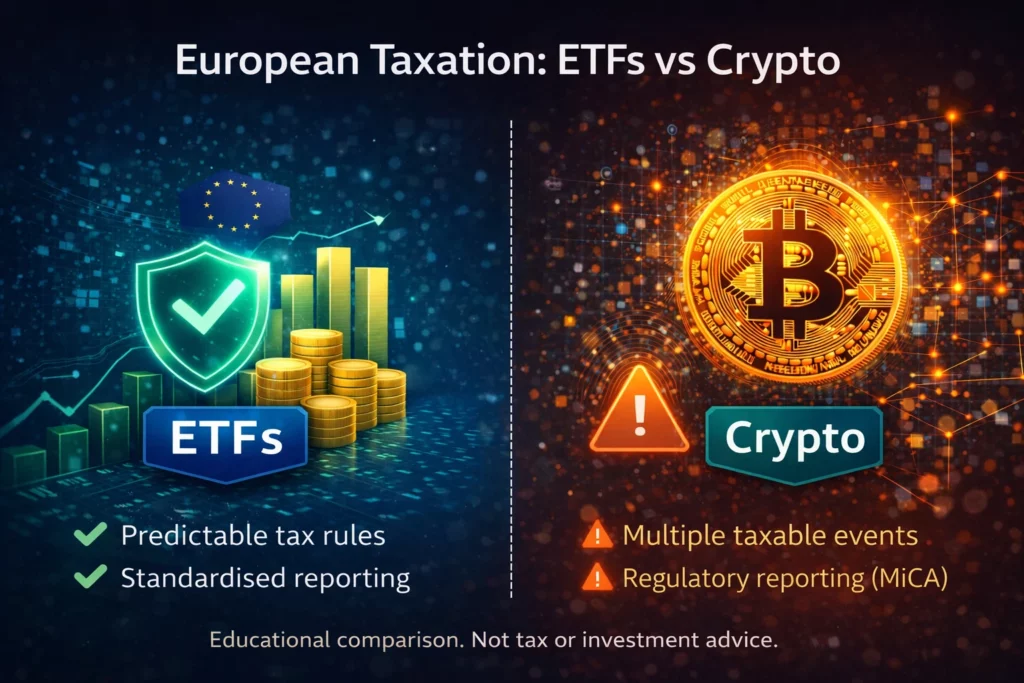
Taxes are where the “ETFs vs crypto” comparison stops being theoretical. You can accept volatility, disagree with regulators, and still face the same constraint: a taxable event.
In 2026, crypto reporting also becomes harder to ignore.
UCITS ETFs: predictable structure, country-specific tax
For UCITS ETFs, the tax logic is relatively stable across Europe:
- Dividends: typically subject to fund-level withholding tax around 15% for Irish- or Luxembourg-domiciled ETFs, often reduced to 10–15% via double taxation treaties (depending on source country and index composition). At investor level, taxation follows national rules.
- Capital gains: usually taxed upon sale, according to domestic legislation.
- Accumulating share classes: defer cash distributions, but do not eliminate taxation — timing and mechanics remain country-specific.
Unexciting. And that’s the point.
Crypto: taxable events and reporting under DAC8
Crypto taxation remains far less harmonised. In most EU countries, crypto-to-crypto transactions are taxable, meaning portfolio rebalancing can trigger multiple taxable events.
From 2026, DAC8 introduces mandatory cross-border reporting by Crypto-Asset Service Providers (C
ASPs), aligned with MiCA licensing. Transaction visibility for tax authorities increases materially. Enforcement risk follows.
This is not a theoretical change.
Country snapshot (indicative, corrected)
| Country | ETF capital gains | ETF dividends | Crypto capital gains | Crypto reporting (DAC8 2026) |
|---|---|---|---|---|
| Germany | 25% + Solidaritätszuschlag (effective 26.375%) | typically 15–26%, structure-dependent | 0% if held >1 year, otherwise up to 26.375% (higher rates only for specific high-income cases) | CASP reporting mandatory |
| France | 30% flat tax (PFU) | 30% effective, including social charges | 30% flat tax above thresholds | Formulaire 2086 + DAC8 |
| Italy | 26% | 26% | 26% | standard income reporting + DAC8 |
| Spain | 19–28% | 19–28% | 19–28% | CNMV + DAC8-linked reporting |
Two things stand out:
- ETFs are tax-predictable. That is their main advantage.
- Crypto is tax-fragmented. Rates may look similar, but reporting and transaction complexity are not.
The friction is rarely the headline tax rate. It is the documentation burden.
UCITS ETFs arrive with KIDs, broker tax statements, and standardised reporting. Crypto investors often need to reconstruct trades across exchanges, wallets, and token swaps — and from 2026 onward, tax authorities will increasingly see the same data.
Disclaimer: This section is general information, not tax advice. Always verify local tax rules and reporting obligations, particularly as DAC8 implementation progresses.
Investor Protection and Risk: UCITS vs Crypto under MiCA
This is where the difference between ETFs and crypto in Europe becomes impossible to ignore. Not in returns. In what happens when things go wrong.
UCITS and MiCA are built for very different failure scenarios — and they protect investors in very different ways.
UCITS: protection by design
UCITS ETFs are constructed around the assumption that markets will fail from time to time. Liquidity dries up. Prices gap. Investors panic. The framework plans for this.
Key protection layers include:
- Strict diversification rules, limiting single-issuer and counterparty exposure
- Independent custody, with clear asset segregation
- Daily liquidity, supported by authorised participants and market makers
- Liquidity management tools (LMTs), further strengthened by ESMA RTS effective from December 2025
If a UCITS ETF provider fails, assets remain ring-fenced. If markets become stressed, trading can be paused or structured in a controlled way. This is boring infrastructure doing its job.
According to repeated guidance from ESMA, UCITS is designed to minimise structural loss — losses caused by product failure rather than market movement.
Market risk remains. Product risk is reduced.
MiCA: supervised access, limited protection
MiCA takes a different approach. It focuses on regulating intermediaries, not on protecting portfolios.
Under MiCA, licensed Crypto-Asset Service Providers (CASPs) must meet governance, capital, and conduct standards. Client assets must be segregated. Risk warnings must be explicit. That is progress.
But there are limits:
- No diversification rules
- No liquidity backstops
- No equivalent to UCITS-style LMTs
- No guarantee of orderly markets during stress
If a crypto platform fails, recovery depends on custody arrangements and operational execution. If markets collapse, there is no regulatory mechanism to slow things down.
ESMA has been explicit on this point. MiCA does not provide investor protection comparable to regulated fund products. It reduces opacity. It does not absorb shocks.
Custody: the non-negotiable difference
Custody is where theory turns into reality.
With UCITS ETFs, custody is external, audited, and legally segregated. With crypto, custody is binary:
- you control the keys
- or you trust a third party
Self-custody introduces operational risk. Third-party custody introduces counterparty risk. MiCA improves standards, but it does not eliminate this trade-off.
There is no equivalent of a depositary bank standing behind a crypto wallet.
Fraud, misconduct, and the “halo effect”
One of the more subtle risks is perception. ESMA has warned about the “halo effect”: the idea that a licensed platform makes all products offered on it feel safer than they actually are.
This matters because MiCA regulates platforms, not tokens. High-risk assets remain high-risk, even when sold by compliant intermediaries.
UCITS does not have this ambiguity. If a product exists, it has already passed a narrow eligibility filter.
The practical takeaway
If your primary concern is investor protection and operational robustness, UCITS ETFs sit at the conservative end of the spectrum. If your priority is direct exposure and asymmetric upside, crypto remains the more flexible — and fragile — option.
Neither is “better” in isolation. But they are not substitutes.
Confusing access with protection is one of the most common mistakes European investors make.
Common Mistakes European Investors Make with ETFs and Crypto
Most problems in the ETFs-vs-crypto debate do not come from market timing. They come from misunderstanding the framework. The rules are there. They are just often ignored.
1. Assuming regulation equals protection
MiCA regulation does not turn crypto into a UCITS-like product. It regulates who can sell and custody crypto, not how risky the asset is.
This is the most common error. Investors see a licensed platform and assume fund-level safeguards. Those do not exist. As repeatedly stressed by ESMA, MiCA reduces opacity — it does not absorb losses.
Regulated access is not the same as protected capital.
2. Expecting UCITS ETFs to provide crypto exposure
Some investors buy “blockchain”, “digital assets”, or “innovation” ETFs assuming indirect crypto exposure.
In reality, UCITS ETFs cannot hold crypto directly. At most, they gain limited exposure via equities, futures-linked instruments, or tightly capped delta-one structures. If you want price exposure to Bitcoin or Ethereum, UCITS is the wrong vehicle.
This misunderstanding leads to disappointment — and misallocation.
3. Ignoring tax timing and transaction volume
Crypto investors often focus on headline tax rates and miss the mechanics.
In most EU countries:
- crypto-to-crypto trades are taxable
- frequent rebalancing multiplies reportable events
- from 2026, DAC8 reporting increases visibility for tax authorities
ETFs behave differently. Fewer taxable events. Standardised broker reporting. Predictable documentation.
The mistake is not paying tax. It is creating unnecessary complexity.
4. Confusing accumulating ETFs with tax exemption
Accumulating UCITS ETFs defer distributions. They do not eliminate taxation.
Depending on the country, reinvested income may still be subject to annual taxation or minimum assessment rules. Investors often discover this late — usually after the first tax notice arrives.
Deferral is not exemption. That distinction matters.
5. Underestimating custody risk in crypto
Self-custody is often presented as empowerment. It is also operational risk.
Lost keys, compromised wallets, or failed backups are not theoretical edge cases. They are permanent loss events. Third-party custody shifts the risk — it does not remove it.
UCITS ETFs avoid this entirely through external depositaries and asset segregation. Crypto does not.
6. Overconcentrating “because it’s not correlated”
Crypto’s low historical correlation with traditional assets is frequently used to justify large allocations.
Correlation changes. Volatility does not disappear. Concentrated positions amplify drawdowns, especially when liquidity dries up.
Diversification is not optional just because the asset feels different.
7. Treating ETFs and crypto as substitutes
This is the most subtle mistake — and the most damaging.
ETFs and crypto solve different problems:
- UCITS ETFs optimise access, diversification, and operational safety
- Crypto optimises direct ownership and asymmetric payoff
They are not interchangeable. Comparing them as if one should replace the other leads to poor portfolio design.
A simple rule that avoids most mistakes
Use UCITS ETFs when you want regulated structure and predictability.
Use crypto only when you consciously accept volatility, custody risk, and tax complexity.
Most errors happen when investors think they are getting one — but are actually buying the other.
ETFs vs Crypto in a European Portfolio: Core, Satellite and Reality
Once regulation, taxes, and risk are clear, one question remains.
How does this actually fit into a portfolio?
In practice, European investors who combine ETFs and crypto tend to fall into a core–satellite structure, whether they label it that way or not.
The core is almost always built from UCITS ETFs. Broad equity and bond funds provide diversification, daily liquidity, and predictable taxation. This is the part of the portfolio designed to survive market stress without structural failure. Not exciting. Intentionally so.
Crypto, when included, sits in the satellite. Small, volatile, and clearly ring-fenced. Its role is asymmetric exposure, not stability.
A simplified view makes the trade-offs visible:
- Conservative profile: UCITS ETFs dominate; crypto exposure is zero or negligible.
- Balanced profile: ETFs remain the core, with a small crypto allocation used opportunistically.
- Aggressive profile: Crypto allocation increases — but even here, a 20% share already implies extreme volatility and large drawdown risk.
This is where many investors misjudge their own tolerance. A portfolio that looks reasonable on paper can feel unmanageable once crypto drawdowns exceed 50%. That psychological dimension matters more than most allocation models admit.
EU focus: when legal wrappers define portfolio structure
Across the EU, portfolio construction is often shaped less by preference and more by legal wrappers.
Many member states offer tax-advantaged investment accounts designed around regulated securities such as UCITS ETFs. France’s PEA is a clear example, but it is not unique in spirit. Similar long-term savings vehicles exist elsewhere, each with its own eligibility rules and constraints.
What they share is equally important: crypto-assets are almost always excluded.
UCITS ETFs, provided they meet domicile and eligibility requirements, can sit inside these wrappers and benefit from deferred or reduced taxation over time. Crypto-assets cannot. There is no equivalent EU-wide structure that allows crypto to be held within a tax-privileged wrapper.
The result is practical rather than theoretical. Even investors who want exposure to both ETFs and crypto end up separating them by necessity. Regulated ETFs form the long-term, tax-efficient core. Crypto, if held at all, sits outside the wrapper, fully exposed to flat taxation, reporting obligations, and custody risk.
This separation is not accidental. It reflects a broader EU policy choice: tax advantages are reserved for products that meet UCITS-level investor protection standards. MiCA supervision does not change that.
A brief market reality check
Market data reinforces this behaviour rather than contradicting it. By 2025, European ETF assets had reached record levels, driven primarily by UCITS index funds. Crypto adoption has continued to expand, but largely outside fund structures, through direct holdings or ETNs.
The absence of spot Bitcoin ETFs in Europe is not an accident. It reflects a deliberate regulatory choice: containment within UCITS, supervision within MiCA, and no convergence between the two.
That split is unlikely to close in 2026.
In other words, the portfolio patterns observed today are not temporary. They are a direct outcome of European regulation — and they explain why ETFs and crypto, despite frequent comparison, rarely play the same role.
Conclusion
By 2026, the choice between ETFs and crypto in Europe is no longer about innovation versus tradition. It is about structure versus exposure.
UCITS ETFs sit inside a mature legal framework that prioritises diversification, custody, liquidity, and predictable taxation. Crypto-assets, even under MiCA, remain fundamentally different: directly owned, highly volatile, and only partially shielded by regulation that focuses on intermediaries rather than outcomes.
The uncomfortable reality is this. MiCA does not turn crypto into a regulated investment product in the UCITS sense, and UCITS ETFs will not evolve into crypto vehicles. The regulatory gap is intentional. European policymakers have chosen containment for funds and supervision for crypto — not convergence.
Taxes, reporting, and custody amplify the difference. DAC8 will make crypto activity far more visible to tax authorities. UCITS ETFs will continue to feel administratively boring. For most investors, boring is efficient.
So the real decision is not “ETFs or crypto?”. It is what role each can realistically play in a European portfolio, given regulation, taxes, and risk tolerance. Confusing access with protection — or volatility with diversification — remains the fastest way to get it wrong.
Key Takeaways
- UCITS and MiCA solve different problems. UCITS is designed for investor protection and fund stability; MiCA regulates crypto service providers, not crypto risk.
- UCITS ETFs cannot hold crypto directly. Any exposure is indirect, capped, and tightly supervised under ESMA guidance.
- MiCA improves supervision, not safety. Licensed platforms reduce opacity, but volatility, custody risk, and loss remain with the investor.
- Tax treatment diverges sharply. UCITS ETFs offer predictable reporting; crypto creates frequent taxable events and, from 2026, mandatory DAC8 reporting.
- Custody is the dividing line. UCITS relies on external depositaries and asset segregation; crypto custody is either self-managed or dependent on intermediaries.
- Regulation does not equal protection. This is true for crypto under MiCA and often misunderstood by retail investors.
- ETFs and crypto are not substitutes. They can coexist in a portfolio, but only if their roles and risks are clearly separated.
FAQ: ETFs vs Crypto in Europe (2026)
ETFs operate inside the UCITS framework, which prioritises diversification, custody, liquidity, and disclosure. Crypto assets sit outside that structure. Even under MiCA, they remain directly owned, volatile instruments without fund-level safeguards.
Different architecture. Different risks.
No. MiCA regulates service providers, not returns or volatility. It improves supervision and transparency, but it does not provide UCITS-style investor protection. Losses remain possible and unbuffered.
No. UCITS ETFs cannot hold crypto directly. Any exposure must be indirect and tightly capped. If you want direct price exposure to crypto, UCITS is not the vehicle.
Because crypto-assets do not qualify as UCITS-eligible assets under EU rules. This position has been reaffirmed by ESMA. Europe prioritises fund containment over product expansion.
MiCA regulates Crypto-Asset Service Providers (CASPs) — exchanges, brokers, custodians, and issuers. It sets licensing, capital, and conduct rules. It does not standardise crypto assets or reduce their market risk
UCITS ETFs follow predictable national tax rules and standardised reporting. Crypto taxation varies widely and often treats each transaction as a taxable event. From 2026, DAC8 introduces mandatory reporting by CASPs, increasing visibility for tax authorities.
In most EU countries, yes. Swapping one token for another is typically a taxable disposal. This is a common surprise for new investors.
Yes. UCITS ETFs rely on external, regulated depositaries with asset segregation. Crypto custody is either self-managed (key risk) or delegated to an intermediary (counterparty risk). MiCA improves standards, but it does not remove this trade-off.
They can — but they serve different roles. ETFs provide structure and diversification; crypto provides direct exposure and asymmetric payoff. Treating them as substitutes usually leads to poor risk management.
Assuming that regulation equals protection. This is false for crypto under MiCA and often misunderstood. Understanding the framework matters more than picking the asset.
Iva Buće is a Master of Economics specializing in digital marketing and logistics. She combines analytical thinking with creativity to make financial and investment topics accessible to a broader audience. At Finorum, she focuses on translating complex economic concepts into clear, practical insights for everyday readers and investors.
Sources & References
EU regulations & taxation
- European Commission / Taxation & Customs — Crypto-Asset Service Providers (CASPs)
- DAC8
- ESMA Final Report on UCITS Eligible Assets
- ESMA guidance
- ESMA warnings
- Investor protection
- Markets in Crypto-Assets Regulation (MiCA)
- MiCA licensing
- MiFID II
- stablecoins
- UCITS Directive
- PwC Tax Summaries — Italy
- Winheller.com — how transactions are reported to tax authorities