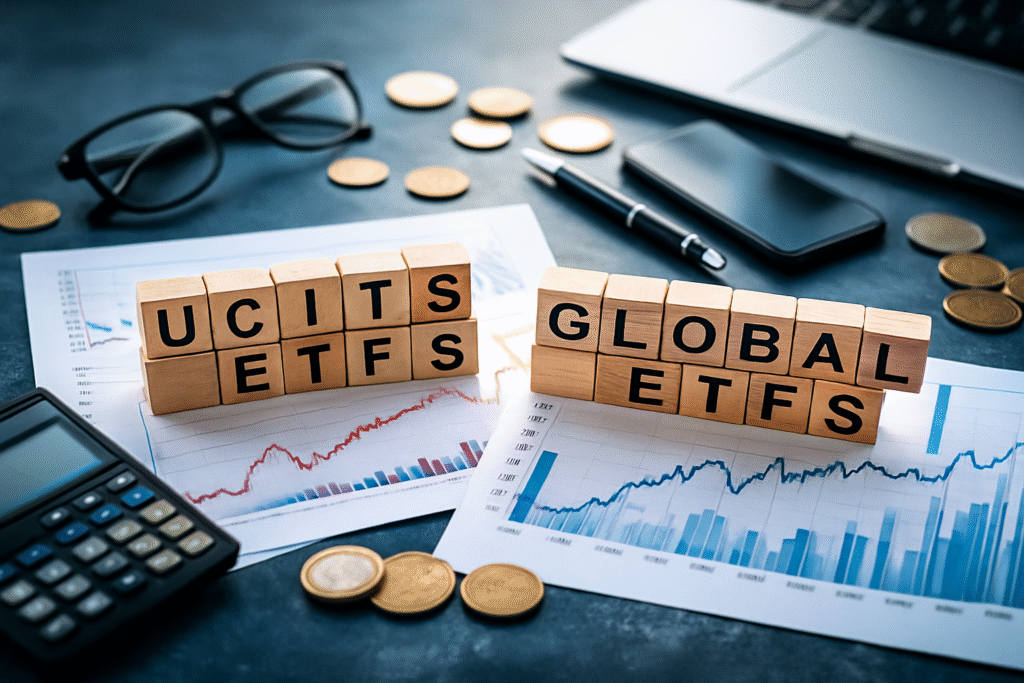

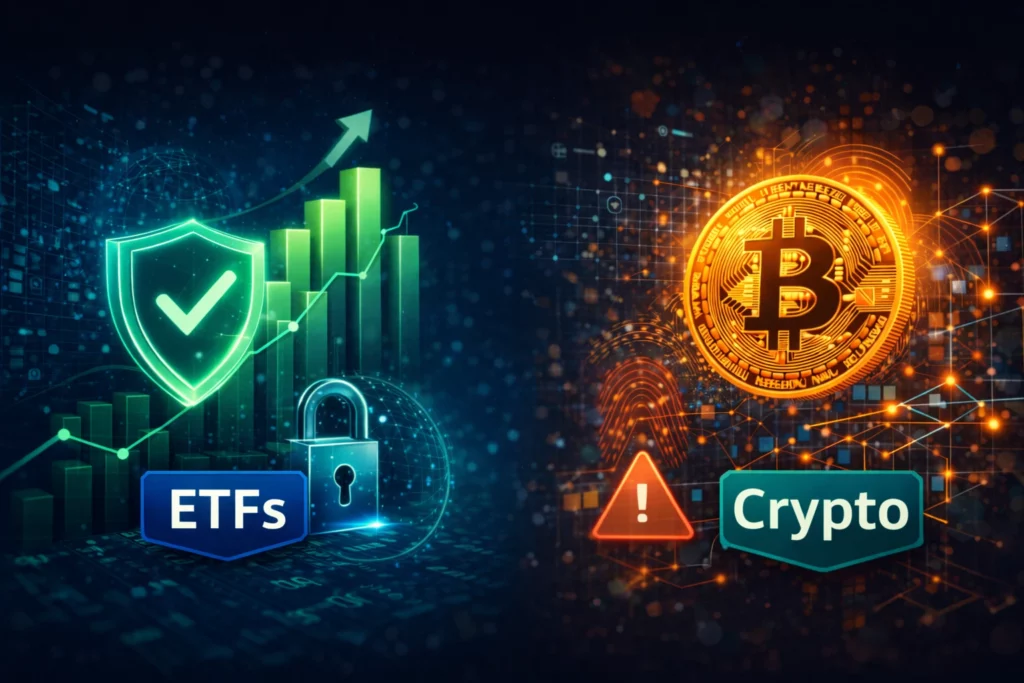
ETFs vs crypto in Europe is a practical choice about where your savings belong. For most beginners investing for the long term, a broad global equity UCITS ETF is the stronger starting point. It spreads money across businesses and markets without requiring you to manage a crypto wallet or build your portfolio around the fortunes of a single asset.
Crypto can have a place alongside that portfolio, provided a substantial loss would not derail your plans. Buying it through an exchange-traded product makes access more convenient, but does not remove the underlying investment risk.
The comparison needs one qualification: “ETF” describes a structure, not a level of safety. A diversified global equity fund is a different proposition from a leveraged or narrowly focused ETF. Money needed for emergencies or an approaching house purchase should be assessed separately from both equities and crypto.
Prepared for 2027 using sources checked on 27 September 2026. Future fee changes are identified explicitly; national tax rules should be checked again for the relevant tax year.
Quick answer: where does each investment fit?
| Broad equity UCITS ETF | Direct crypto | Crypto ETP or ETN | |
|---|---|---|---|
| What you own | Units or shares in an investment fund | Crypto-assets held with a provider or in your own wallet | A security providing crypto exposure |
| Main source of returns | Business performance and stock-market valuations | Demand, adoption, liquidity and asset-specific developments | Underlying crypto prices, adjusted for fees and product structure |
| Diversification | Broad if the chosen index is broad | Limited with one coin; several coins can share similar risks | Depends on the assets tracked |
| What you must manage | Fund selection, broker and contributions | Provider or wallet security, transactions and records | Product terms, broker and issuer-related risks |
| Potential portfolio role | Long-term equity foundation | Optional high-risk holding | Optional high-risk holding through a securities account |
If you are building your first portfolio, establish the diversified foundation before deciding whether to add crypto. You do not need both to have a complete investment plan.
Start with what you actually own
A brokerage app can put a global ETF and a Bitcoin product next to each other. The purchase process looks similar. Your rights, exposure and responsibilities can be quite different.
A UCITS ETF gives you an interest in a fund
Buying an equity UCITS ETF gives you units or shares in a fund that follows a defined investment strategy. With a broad global index, your money is spread across many companies rather than tied to one business.
There will still be concentrations. A market-cap-weighted fund can have substantial exposure to its largest companies, sectors or countries. Diversification reduces dependence on individual holdings; it does not stop the portfolio from falling during a stock-market downturn.
The EU UCITS framework sets requirements covering areas such as eligible investments, diversification, disclosures and depositary oversight. These rules govern the fund’s operation. They do not guarantee its value.
That is why a comparison of UCITS ETFs vs Bitcoin should identify the fund being discussed. A global equity ETF, a government-bond ETF and a leveraged technology ETF cannot sensibly be treated as interchangeable.
Finorum’s guide to choosing UCITS ETFs explains the checks to make before buying.
Direct crypto brings a custody choice
If you buy Bitcoin through a platform and leave it there, you rely on that provider’s custody and withdrawal arrangements.
Transferring it to a self-custody wallet changes the responsibility. You control the keys and must have a reliable way to secure and recover them.
Before making that transfer, you should be able to answer a few ordinary questions. What happens if the device breaks? Where is the recovery phrase stored? Could someone recover the assets if you died? Do you understand the network and address you are sending to?
A hardware wallet helps with one part of this process. It cannot undo an authorised transfer to the wrong destination or protect a recovery phrase that you disclose.
For some investors, managing custody is an acceptable part of owning crypto. Others would rather avoid it. That preference helps determine which route is workable.
A crypto ETP gives you a security
The crypto ETP vs ETF distinction is easy to overlook because both products trade on exchanges.
“Exchange-traded” tells you how a product is bought and sold. It does not mean that every product is a UCITS fund or has the same legal protections.
With a crypto ETP or ETN, examine the legal form, backing arrangements, custodian and redemption terms. Physical backing is useful information, but it does not eliminate every operational or issuer-related risk.
For example, the iShares Bitcoin ETP documentation describes securities backed by Bitcoin held by a custodian. It also explains that ordinary investors buying and selling on the secondary market do not take delivery of Bitcoin.
An ETP can therefore provide price exposure through a securities account. It does not necessarily give you coins that you can withdraw to a personal wallet or use on-chain.
Put a possible loss into euros
A “small crypto allocation” sounds manageable until you decide what small means.
Take a €1,000 portfolio and assume that, over the same period, its equity ETF falls 30% and its crypto holding falls 70%. There is no rebalancing, and the calculation excludes fees and taxes.
| Starting allocation | Loss on ETF holding | Loss on crypto holding | Total portfolio loss | Amount remaining |
|---|---|---|---|---|
| 100% ETF / 0% crypto | €300 | €0 | €300 — 30% | €700 |
| 95% ETF / 5% crypto | €285 | €35 | €320 — 32% | €680 |
| 90% ETF / 10% crypto | €270 | €70 | €340 — 34% | €660 |
| 80% ETF / 20% crypto | €240 | €140 | €380 — 38% | €620 |
Finorum calculation using hypothetical losses. This is a stress test, not a forecast, historical comparison or recommended allocation.
The formula is:
Portfolio return = (ETF weight × ETF return) + (crypto weight × crypto return)
For the 90/10 portfolio:
(0.90 × −30%) + (0.10 × −70%) = −34%
The point is to see how crypto allocation affects portfolio risk when both investments fall together. Adding crypto does not guarantee protection against an equity-market decline.
You can also work backwards from an affordable loss. If a crypto holding became worthless, a 5% starting allocation would directly cost 5% of the starting portfolio, assuming the other holdings stayed unchanged. Whether that is acceptable is a more useful question than whether 5% sounds conservative.
Your original allocation will not stay fixed
Suppose you invest €900 in an ETF and €100 in crypto. If the crypto holding doubles while the ETF stays flat, crypto becomes approximately 18.2% of the €1,100 portfolio.
A position that began at 10% now accounts for almost a fifth of your money.
Decide beforehand whether you will rebalance, redirect future contributions or accept that drift. Selling to rebalance can create a tax liability, so the policy needs to work with your country’s rules.
What the choice looks like in real life
You have €1,000, but little money set aside
Keep the immediate financial problem in view. If an unexpected bill would force you to sell investments or borrow, building a cash reserve takes priority.
The amount available to invest is what remains after allowing for those needs. A promising investment cannot make an emergency arrive at a convenient time.
Once a reserve is in place, Finorum’s €1,000 ETF portfolio guide explains how to approach a small starting portfolio.
You can invest €200 a month for a distant goal
A broad ETF savings plan offers a manageable routine: select an appropriate fund, check the purchase costs and contribute consistently.
Dividing €200 among several products adds transactions and recordkeeping. Before adding crypto, decide what role it serves and how much loss you can accept from that position.
Keeping the portfolio simple is a reasonable choice, especially while you are learning.
You already have a substantial investment portfolio
An investor with adequate cash reserves and a diversified portfolio has more room to consider a speculative holding.
The size still matters. A €5,000 crypto position is 2% of a €250,000 investment portfolio and 50% of a €10,000 portfolio. The purchase is identical; its consequences are not.
A high income alone does not establish risk capacity. Debt, upcoming spending and job security belong in the calculation too.
Compare the costs you will actually pay
The annual product charge is only part of the bill.
For an ETF, check the ongoing charge, trading commission, bid–ask spread and any currency-conversion fee. Direct crypto purchases can involve spreads, trading fees and withdrawal charges. Self-custody can add hardware and network costs.
A crypto ETP combines a recurring product charge with the costs of trading through your broker.
| Cost example | Effect |
|---|---|
| 0.20% annual charge on a constant €10,000 holding | Approximately €20 a year |
| €2 commission on a €100 purchase | 2% of the purchase amount |
| €2 commission on a €1,000 purchase | 0.2% of the purchase amount |
| 0.50% crypto purchase fee on €1,000 | €5 before other charges |
Illustrative calculations, not a market-wide fee schedule. Ongoing percentage charges change with the value of the holding.
For someone investing small amounts each month, a fixed transaction fee can matter more than a modest difference in annual charges.
Also check when promotional pricing ends. The iShares Bitcoin ETP’s published schedule specifies a reduced annual charge of 0.15% through 31 December 2026 and 0.25% from 1 January 2027. On a constant €10,000 holding, that is approximately €15 and €25 a year respectively. Source: issuer’s fee schedule.
This is a product-specific illustration, not an endorsement. A low fee does not make a high-risk investment suitable.
What protection does MiCA provide?
MiCA investor protection matters when choosing a crypto provider. It does not turn the assets sold by that provider into guaranteed investments.
The EU’s Markets in Crypto-Assets Regulation covers specified crypto-asset issuers, offers and services. Its stablecoin provisions began applying on 30 June 2024; the broader framework followed on 30 December 2024. AMF overview of MiCA.
For qualifying existing providers, the maximum transitional period ended on 1 July 2026. Some countries used shorter periods. An old national registration therefore does not, by itself, establish that a provider has the necessary status for operating in 2027. ESMA’s transitional provisions.
Check the legal entity serving you and the services it is permitted to provide. The company name in your account agreement is more useful for this check than the brand on the app.
The European supervisory authorities warn that crypto protections remain more limited than those attached to many traditional financial products. MiCA does not reimburse a fall in value or provide an equivalent investor-compensation safety net. Joint supervisory warning on crypto-assets.
Crypto ETPs need a separate check. Assets qualifying as financial instruments fall outside MiCA’s scope and are instead subject to the relevant financial-services framework. Their legal classification determines the applicable rules. MiCA Article 2.
Taxes can change the comparison
There is no single European tax treatment for ETFs or crypto.
Your tax residence, the product you hold and the transaction you make all affect the result. Buying on a German exchange does not automatically give a French resident German tax treatment.
The following examples explain differences in published rules checked in September 2026. They should not be read as confirmation that every national provision will remain unchanged throughout 2027.
Germany: the holding period matters for direct crypto
For ordinary privately held Bitcoin or Ether, a disposal within one year can fall within Germany’s private-sale income-tax rules. A disposal after more than one year is generally outside that private-sale charge.
Exchanging one crypto-asset for another can count as a disposal. Mining, staking income and business activity require additional analysis. German Finance Ministry guidance.
Do not carry this treatment across to every Bitcoin ETP. The security’s legal structure and rights need their own assessment.
Investment funds follow another regime. For qualifying equity funds held by private investors, Germany provides a 30% partial exemption on relevant fund income. That is a different mechanism from the direct-crypto holding-period rule. Investment Tax Act, Section 20.
France: qualifying crypto swaps can defer tax
Under France’s private-investor regime, an exchange of digital assets without a cash balancing payment benefits from tax deferral.
Converting crypto into euros is a different event. The tax administration identifies form 2086 for reporting relevant private-investor gains and losses; professional activity follows different rules. French tax authority guidance.
You still need the transaction records. A deferred tax charge does not make the earlier trading history irrelevant.
Spain: exchanging coins can realise a gain
Spain treats a cryptocurrency exchange as a barter transaction that can generate a capital gain or loss. The trigger does not require a withdrawal to your bank account. Agencia Tributaria guidance.
For example, assume a Spanish-resident private investor buys crypto for €1,000 and exchanges it when both sides of the swap are worth €1,600. Ignoring fees and other cost-basis complications, the gain for calculation purposes is €600.
That contrasts with the immediate treatment of a qualifying cashless swap under France’s private-investor regime. The same trading decision can produce different tax consequences across the border.
Moving country means reviewing the rules again
Before relocating, save acquisition dates, euro purchase values and complete transaction exports.
Keeping the same broker or wallet does not guarantee that your investments retain the same tax treatment. Establish which residence rules apply and whether the move creates additional reporting obligations.
DAC8: why 2027 matters for crypto records
Crypto tax reporting in Europe is becoming more systematic through DAC8.
The first reporting year is 2026. Reporting providers collect information and submit it under domestic requirements. The first exchanges between EU tax authorities, covering 2026, are due by 30 September 2027. That is not a universal deadline for investors’ personal tax returns. European Commission’s DAC8 guidance.
DAC8 expands information reporting. It does not establish one EU crypto tax rate or replace your responsibility to file correctly.
Keep enough information to reconstruct what happened:
- acquisition and disposal dates;
- quantities and euro values;
- fees;
- transfers between your own wallets and accounts;
- staking or other receipts;
- platform statements and transaction identifiers.
Download records regularly. A platform receiving coins from another wallet might not have the information needed to establish their original purchase cost.
How to choose without overcomplicating the portfolio
Start with the purpose of the money, then select the investment and account.
| What you need | What to consider first |
|---|---|
| Money for emergencies or an approaching purchase | Keep the required amount outside equity and crypto risk |
| Long-term exposure to businesses across markets | A broad UCITS equity ETF |
| Crypto that you can transfer or use on-chain | Direct ownership with a custody plan you understand |
| Crypto price exposure through a securities account | An available ETP whose legal terms you have reviewed |
| A limited speculative position | Set an affordable maximum loss before buying |
| Less administration | Reduce unnecessary products, accounts and transactions |
If you are asking “should beginners invest in ETFs or crypto?”, a diversified equity ETF is generally the more workable foundation for long-term investing. Crypto needs its own investment case and a willingness to absorb severe losses.
Before adding it, write down why you want the exposure, its maximum acceptable size and the circumstances in which you would reduce it. Those decisions are easier to make before prices start moving.
FAQ
Is a blockchain ETF the same as owning Bitcoin?
No. A blockchain-themed equity ETF owns shares in companies selected by its strategy. Their performance depends on business costs, financing, management and stock-market valuations as well as developments in the crypto industry. They do not have to track Bitcoin closely.
Does buying an ETF in euros remove currency risk?
No. The trading currency tells you how the purchase is settled. Currency exposure depends on the underlying investments and any hedging policy. A euro trading line alone does not provide a hedge.
Can a Bitcoin ETP move sharply when the exchange reopens?
Yes. Crypto markets continue trading while securities exchanges are closed. A substantial move in the underlying asset can therefore lead to a different ETP price when trading resumes. A limit order sets your acceptable execution price, but does not guarantee that the trade will happen.
Are accumulating ETFs tax-free until you sell?
No. Reinvesting income within a fund does not determine its tax treatment. Some countries can impose tax before a sale. Finorum’s accumulating vs distributing ETFs guide explains the distinction.
Does owning several cryptocurrencies provide enough diversification?
It spreads exposure across projects, but those projects can remain sensitive to the same crypto-market conditions. It does not replicate ownership across the businesses and industries represented in a broad global equity fund.
Which will earn more in 2027: ETFs or crypto?
Nobody can establish that in advance. Costs, concentration, ownership rights and possible losses can be compared today. Next year’s winning investment cannot be identified with certainty.
Disclaimer: The information provided on Finorum is for educational and informational purposes only and does not constitute personalised financial, investment or tax advice. Investing involves risk, including the potential loss of capital. Always conduct your own research and, where needed, consult a qualified financial or tax adviser before making investment decisions. Tax treatment depends on individual circumstances and applicable rules, which can change over time.
Iva Buće is a Master of Economics specializing in digital marketing and logistics. She combines analytical thinking with creativity to make financial and investment topics accessible to a broader audience. At Finorum, she focuses on translating complex economic concepts into clear, practical insights for everyday readers and investors.
Sources & References
EU regulations & taxation
- European Commission / Taxation & Customs — ESMA’s transitional provisions
- European Commission’s DAC8 guidance
- EU UCITS framework
- Joint supervisory warning on crypto-assets
- MiCA Article 2
- Gesetze-im-internet.de — Investment Tax Act, Section 20
- Impots.gouv.fr — French tax authority guidance